Non-Stimulant ADHD Titration: Guanfacine & Atomoxetine UK Guide 2026
Non-Stimulant ADHD Titration: Guanfacine and Other Options
If stimulants aren't suitable for your ADHD—or you're seeking a non-controlled, lower-abuse-risk alternative—non-stimulant medications like guanfacine and atomoxetine offer evidence-based options with structured titration pathways.
Why Consider Non-Stimulant ADHD Medications?
Non-stimulants are typically second-line in UK practice, recommended when stimulants (methylphenidate or lisdexamfetamine) are ineffective, not tolerated, contraindicated, or declined due to personal preference or substance-misuse risk. They're not Schedule 2 controlled drugs, which simplifies prescribing and reduces regulatory burden.
Key scenarios where non-stimulants may be preferred:
History of substance misuse or diversion risk
Significant anxiety, tics, or Tourette's where stimulants worsen symptoms
Cardiovascular concerns requiring cautious stimulant use
Patient preference for non-controlled medication
Inadequate response to multiple stimulant trials
Guanfacine (Intuniv): Alpha-2A Agonist for ADHD
Guanfacine extended-release (ER) is a selective alpha-2A adrenergic receptor agonist licensed for children and adolescents (6–17 years) in the UK, with off-label use in adults. It works by enhancing prefrontal cortical regulation of attention and impulse control, with particular benefit for emotional dysregulation and hyperactivity.
Guanfacine Titration Schedule
Starting dose: 1 mg once daily (evening dosing often preferred to reduce daytime somnolence).
Titration: Increase by no more than 1 mg per week, based on response and tolerability.
Target maintenance dose: 0.05–0.12 mg/kg/day (typically 1–7 mg/day total).
Maximum doses by age/weight:
Children 6–12 years (≥25 kg): 4 mg/day maximummedicines.
Adolescents 13–17 years (≥58.5 kg): up to 7 mg/day after tolerating 6 mg/day for ≥1 weekmedicines.
Adults (off-label): 4–6 mg/day commonly targeted, using ~0.1 mg/kg as a guide
Example titration (child ≥25 kg):
Week 1: 1 mg once daily
Week 2: 2 mg once daily
Week 3: 3 mg once daily
Week 4: 4 mg once daily (maximum for this weight group)medicines.
Time to effect: Clinical benefits may emerge within 2–4 weeks, with full effect by 6–8 weeks.
Guanfacine Monitoring Requirements
Guanfacine can cause hypotension, bradycardia, and syncope—particularly during titration and after discontinuation.
Baseline and ongoing monitoring:
Blood pressure and heart rate at baseline, weekly during titration, every 3 months in year 1, then every 6 months (more frequently after dose changes)
Watch for somnolence, fatigue, dizziness, abdominal pain, and decreased appetitemedicines.
Do not stop abruptly—taper gradually to avoid rebound hypertension
Atomoxetine (Strattera): Noradrenaline Reuptake Inhibitor
Atomoxetine is a selective noradrenaline reuptake inhibitor (SNRI) licensed for both children (from age 6) and adults in the UK. It's often the first non-stimulant tried in adults and is NICE-recommended when stimulants are unsuitable.
Atomoxetine Titration Schedule
Children ≤70 kg body weight:
Starting dose: ~0.5 mg/kg/day
Maintenance after ≥7 days: ~1.2 mg/kg/day (no additional benefit above this)
Maximum: 1.8 mg/kg/day not systematically evaluated
Children >70 kg and adults:
Starting dose: 40 mg once dailymedicines.
Increase after: Minimum 3 days (some protocols use 7 days)medicines.
Maintenance dose: 80 mg/day (some require up to 100 mg/day)medicines.
Maximum: 100 mg/day (single doses >120 mg and daily >150 mg not evaluated)
Time to effect: 4–8 weeks for full therapeutic benefit; early improvements may appear at 2–4 weeks.
Atomoxetine Safety and Monitoring
Atomoxetine carries specific warnings requiring proactive monitoring:
Suicidal ideation: Pooled paediatric trials showed 0.4% incidence vs 0% placebo. Monitor closely for mood changes, especially in first 1–6 weeks and after dose changes.
Liver injury (rare but serious): Postmarketing reports include severe hepatic injury. Discontinue immediately if jaundice, dark urine, pruritus, right upper quadrant pain, or unexplained flu-like symptoms occur. Baseline liver function tests (ALT, AST, bilirubin) are recommended by many clinicians.
Cardiovascular effects: Small increases in blood pressure (1–4 mmHg) and heart rate (1–2 bpm) are common. Monitor BP and HR at baseline, after dose increases, and periodically.
Other considerations:
Not a controlled drug—no Schedule 2 restrictionsnomedic+1
Once-daily or divided dosing (morning and late afternoon)
CYP2D6 metabolism—dose adjustments may be needed with inhibitors or in poor metabolisers
Clonidine and Other Non-Stimulant Options
Clonidine (another alpha-2 agonist) is available in the UK but less commonly used for ADHD than guanfacine. It's prescription-only but not controlled. Recent supply notifications indicate intermittent shortages. Clonidine tends to cause more sedation and hypotension than guanfacine, limiting tolerability.
Other non-stimulant strategies (often adjunctive or off-label):
Bupropion: Sometimes used off-label, particularly when depression coexists
Tricyclic antidepressants (e.g., imipramine, desipramine): Historical use, now rare due to side-effect profile
Modafinil: Not licensed for ADHD in UK; limited evidence
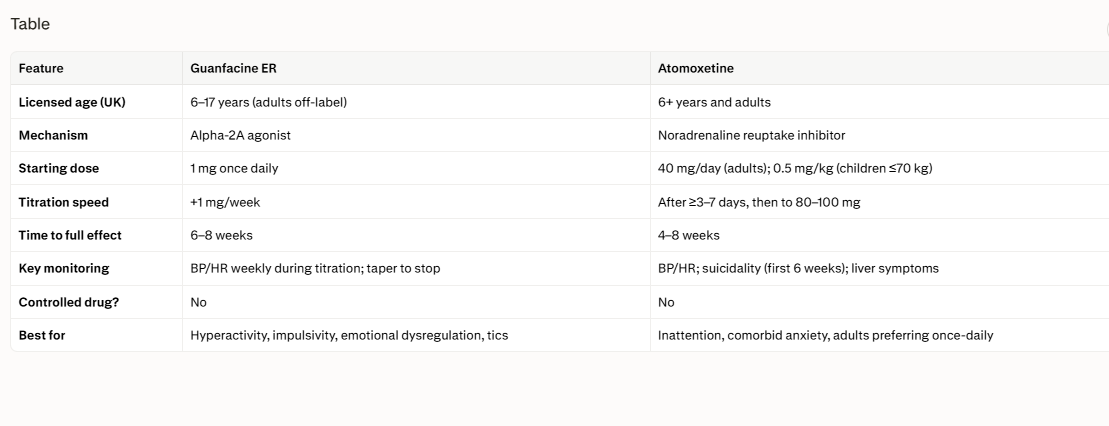
Comparing Non-Stimulant ADHD Medications
Practical Titration Tips for Clinicians and Patients
Start low, go slow: Both medications require gradual escalation to minimise side effects and identify the minimum effective dose.
Schedule reviews every 2–4 weeks: NICE recommends regular contact during titration to assess symptoms, impairment, and adverse effects.
Use weight-based dosing for children: Especially important for guanfacine (0.05–0.12 mg/kg/day) and atomoxetine (0.5 → 1.2 mg/kg/day).
Monitor vitals consistently: Blood pressure and heart rate should be recorded at baseline, after each dose change, and at routine intervals.
Educate on discontinuation: Guanfacine must be tapered to avoid rebound hypertension; atomoxetine can usually be stopped without taper but monitor for mood changes.
Track side effects systematically: Use simple logs for sleep, appetite, mood, focus, and physical symptoms to guide dose adjustments.
When to Switch or Combine Medications
Inadequate response after 8–12 weeks at target dose: Consider switching to another non-stimulant or revisiting stimulant options.
Intolerable side effects: Reduce dose, adjust timing (e.g., evening guanfacine for somnolence), or switch class.
Partial response: Some clinicians combine non-stimulants with low-dose stimulants under specialist supervision, though evidence is limited.
Frequently Asked Questions (FAQs)
How long does non-stimulant ADHD titration take?
Typically 6–12 weeks to reach a stable, effective dose, with atomoxetine sometimes requiring up to 8 weeks for full effect.
Can adults take guanfacine for ADHD?
Guanfacine is licensed for 6–17-year-olds in the UK but is used off-label in adults, often at 4–6 mg/day with careful cardiovascular monitoring.
Do non-stimulants work as well as stimulants?
Response rates are generally lower (40–56% for atomoxetine vs higher for stimulants), but they're valuable when stimulants aren't suitable or tolerated.
What blood tests are needed before starting?
Routine blood tests aren't mandated by NICE, but many clinicians check baseline liver function (for atomoxetine) and always record BP/HR/weight.
Can I drink alcohol while on these medications?
Alcohol may increase sedation with guanfacine and isn't recommended during titration. Discuss with your prescriber.
What if I miss a dose?
Take it as soon as you remember unless it's close to the next dose—don't double up. Consistency matters more with atomoxetine due to its longer onset.
If you're struggling with focus, impulsivity, or emotional regulation—and stimulants haven't been the right fit—non-stimulant options like guanfacine and atomoxetine could offer the stability you need.
Book an ADHD Assessment today and speak with a specialist who can tailor a titration plan to your symptoms, lifestyle, and medical history.
Book Your Private ADHD Assessment →
At Focus Gently, we provide:
Comprehensive, NICE-aligned assessments (60–90 minutes)
Personalised medication planning, including non-stimulant pathways
Ongoing titration support with regular reviews
Shared-care coordination with your GP where appropriate
Don't wait months for answers. Get expert guidance and start your journey to better focus and emotional balance.