Typical UK Timelines for an Adult ADHD Assessment: NHS, Right to Choose & Private Pathways Explained

Typical UK Timelines for an Adult ADHD Assessment: NHS, Right to Choose & Private Pathways Explained
If you suspect you have ADHD, one of the most pressing questions is: “How long will it take to get an assessment and diagnosis in the UK?” The answer depends heavily on which pathway you choose. Standard NHS referrals can take many months to several years, NHS Right to Choose (England only) is often faster but still variable, and private assessments typically offer the quickest route, often within a few weeks to a couple of months.
This guide walks you through the typical UK timelines for adult ADHD assessment across the main routes, what each step involves, and how to plan realistically while you wait.
Step 1: Pre-Assessment – Self-Reflection & Screening (1–2 Weeks)
Before you enter any official pathway, the first stage is personal preparation.
Typical Timeline
1–2 weeks to:
Reflect on your symptoms, history, and day-to-day impact
Complete a recognised screener such as the ASRS (Adult ADHD Self-Report Scale)
Write a short summary for your GP or private clinic
This stage is not counted by services, but it can significantly reduce delays later by making your referral request more convincing and your assessment more focused.
What You Do
Use a validated screener (e.g. ASRS via thinkADHD, Care ADHD, or ADHD UK)
Note key examples: work, relationships, school, daily life
Consider whether issues have been present since childhood
A well-prepared screener and summary can help your GP feel confident that a referral is appropriate, reducing the chance of being dismissed at the first appointment.
Step 2: GP Appointment & Referral Decision (1–4 Weeks)
The next step is speaking to your GP and requesting a referral for an adult ADHD assessment.
Typical Timeline
1–4 weeks to:
Book a GP appointment
Attend the appointment
Receive your referral decision
Some GP practices allow urgent bookings; others may have longer waits. If you’re referred, you’ll usually get a referral letter or electronic referral sent to your local adult ADHD service or mental health team.
Factors That Affect Timing
GP availability and appointment slots
How clearly you present your symptoms and their impact
Whether you bring screener results and a written summary
Local NHS policies on ADHD referrals
If your GP refuses a referral, you may need to:
Request a second opinion
Contact a different GP at your practice
Consider private assessment if cost is feasible
If in England, explore Right to Choose once a referral is agreed
Being prepared with evidence (screener, summary, examples) can make this step faster and more likely to succeed.
Step 3: Standard NHS Referral Route (6 Months to 2+ Years)
Once referred via the standard NHS route, you enter your local adult ADHD service or mental health pathway. This is the most common route but often the slowest.
Typical Timeline
6 months to 2+ years before your first assessment, depending on:
Your region
Local waiting lists
Service capacity
In some areas, people wait over a year just to get assessed. This is one of the main reasons many adults choose Right to Choose or private options.
What Happens
You wait for an appointment (often on a waiting list)
You may be asked to complete additional questionnaires
You attend a specialist assessment (often 45–90 minutes)
You receive a report with diagnosis or not, and recommendations
If diagnosed, you may be offered:
Medication titration under specialist care
Psychological support (e.g. ADHD-focused therapy, coaching)
Shared care arrangements with your GP (where possible)
The timeline here is dominated by waiting for the assessment itself, not by the assessment process.
Step 4: NHS Right to Choose (England Only) – 3–12 Weeks Typical
If you are registered with a GP in England, you may be able to use the NHS Right to Choose pathway to access faster, NHS-funded assessment from a provider you select, rather than waiting on your local service.
Typical Timeline
3–12 weeks from referral to assessment is common, though this varies by provider and area.
Some providers report even faster access for certain patients, but this is not guaranteed.
This is usually significantly faster than standard local referrals in many regions, but still influenced by local demand and available contracts.
The Process
You agree with your GP that an ADHD assessment is appropriate.
You ask your GP to refer you to a specific provider that offers Right to Choose for adult ADHD.
The provider contacts you with an appointment.
You attend your assessment (often online or in-person).
You receive a written report and, if diagnosed, a treatment plan.
The assessment is NHS-funded, so you do not pay for the assessment itself. However, medication and ongoing care arrangements may depend on local policies and GP willingness to enter shared care.
Right to Choose is only available in England. If you’re in Scotland, Wales, or Northern Ireland, you generally rely on the standard NHS route or private assessment.
Step 5: Private Adult ADHD Assessment (2–8 Weeks Typical)
For those who can afford it, or who are not in England, private assessment is often the fastest route.
Typical Timeline
2–8 weeks from first contact to assessment is common, depending on:
The clinic
Your availability
How quickly you complete pre-assessment paperwork
Some clinics can offer appointments within a few weeks; others may have slightly longer waits due to demand.
The Process
You contact a private clinic directly (often no GP referral needed).
You complete pre-assessment questionnaires and sometimes a screener.
You attend a 45–90 minute assessment with a psychiatrist, specialist nurse, or other qualified clinician.
You receive a written report with diagnosis or not, and recommendations.
If diagnosed, you may:
Begin medication titration with the clinic
Request a shared care letter for your GP
Continue with ongoing support from the clinic or move to NHS care where possible
Private timelines are usually dominated by clinic availability and your own readiness to complete forms and attend sessions, rather than by NHS waiting lists.
Step 6: Post-Diagnosis Treatment & Titration (3–12 Months)
After diagnosis, the process doesn’t stop. Many people need medication titration and ongoing support, which adds to the overall timeline before you feel fully stabilised.
Typical Timeline
3–12 months for full titration and stabilisation, depending on:
Medication type
Your response
Service capacity
During this time:
You start at a low dose
Doses are gradually increased while monitoring benefits and side effects
You attend regular follow-ups (often every 4–8 weeks initially)
In the NHS, a specialist may start and stabilise medication, then share care with your GP. In private settings, some clinics provide titration and follow-ups before asking your GP to take over ongoing prescribing.
This phase can be longer if:
You have complex needs (e.g., anxiety, depression, trauma)
You struggle to attend appointments
Your GP is cautious about shared care arrangements
Full Adult ADHD Assessment Timeline Summary (UK)
Putting the steps together, here are realistic ranges for the whole journey from first thoughts to stable treatment:
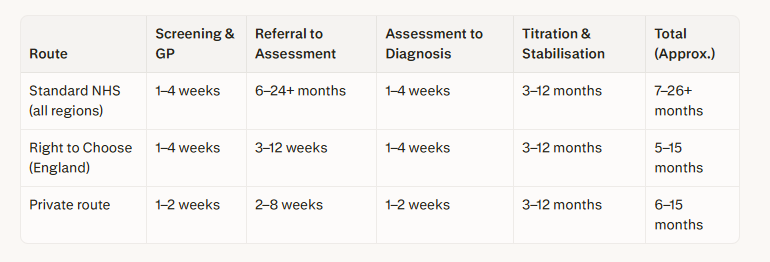
These are realistic ranges, not guarantees. Your actual timeline may be shorter or longer depending on your location, service capacity, and personal circumstances.
What Can Speed Up Your Adult ADHD Assessment Timeline?
Several practical steps can help you move through the process more efficiently:
Complete a recognised screener like the ASRS before seeing your GP.
Bring a clear summary of your symptoms, history, and impact to your GP appointment.
Be persistent: If your GP refuses a referral, ask for a second opinion or a different GP.
Explore Right to Choose if you’re in England and your GP agrees an assessment is appropriate.
Consider private assessment if you can afford it and want faster access.
Organise your records (school reports, old questionnaires, notes) so you’re ready when asked.
These steps reduce unnecessary back-and-forth and can help you avoid long delays caused by poor preparation or unclear communication.
Challenges That Can Lengthen the Timeline
Some factors can make the process slower:
Long NHS waiting lists in your area
GP hesitation about referring for adult ADHD
Misdiagnosis (e.g. anxiety or depression seen as primary issues)
Complex history (e.g. trauma, autism, learning difficulties) requiring more detailed assessment
GP unwillingness to accept private diagnoses or enter shared care
If you face these challenges, you may need to:
Seek a second opinion
Consider private assessment
Ask for support from ADHD charities or advocacy groups
FAQs About Typical UK Timelines for Adult ADHD Assessment
1. How long does it take to get an adult ADHD diagnosis in the UK overall?
Whole journey times vary widely:
Standard NHS: 7–26+ months (often longer in some areas)
Right to Choose (England): around 5–15 months
Private: around 6–15 months, depending on clinic and titration needs.
These ranges include screening, GP referral, assessment, and titration.
2. Is Right to Choose faster than standard NHS referral?
In many areas, yes. Standard NHS referrals often wait 6–24+ months, while Right to Choose commonly offers assessments in 3–12 weeks. However, this depends on your region, provider availability, and current contracts.
3. Can I get a private diagnosis faster than NHS?
Yes. Private assessments often take 2–8 weeks from booking to assessment, compared with many months or years on some NHS waiting lists. This is one of the main reasons people choose private routes.
4. How long does medication titration take after diagnosis?
Titration typically takes 3–12 months, depending on how you respond to medication and how often follow-ups can be scheduled. Some people stabilise faster; others need longer due to side effects or complex needs.
5. Will my GP accept a private adult ADHD diagnosis quickly?
Not always. Some GPs readily accept private reports and enter shared care; others require additional documentation, further assessment, or may decline to prescribe. This variation can add time to your overall timeline, especially for medication.
6. What if my GP refuses a referral for adult ADHD assessment?
You can:
Request a second opinion from another GP at your practice
Ask for a clear explanation of why ADHD is being ruled out
Consider private assessment if you can afford it
If in England, use Right to Choose once a referral is agreed
7. Do children and adults have different timelines?
Yes. Children often go through CAMHS (Child and Adolescent Mental Health Services), which can have very long waiting times. Adults typically go through adult mental health teams or specialist ADHD services. Both routes can take many months or years, depending on location and demand.
8. Can I start treatment before a formal diagnosis?
Generally, NHS medication for ADHD is only started after a formal diagnosis by a specialist. Some private clinics may offer structured support or non-medication strategies before diagnosis, but medication initiation usually follows diagnosis.
Take the Next Step: Book an Adult ADHD Assessment with Focus, Gently
If the UK timelines for adult ADHD assessment feel overwhelming, or you’re unsure whether to wait for NHS care or explore private options, you don’t have to figure it all out alone. Focus Gently offers UK-wide, remote-friendly adult ADHD assessments led by experienced clinicians, with a focus on making the process feel safe, structured, and understandable rather than rushed or intimidating.
Their approach is designed around real human needs:
Simple, clear pre-assessment questions that help you reflect on your symptoms and history without feeling overwhelmed.
A supportive session where you can talk openly, make sense of your information, and get guidance on next steps.
Transparent, compassionate care that respects your pace and your story, rather than treating you as a checklist.
Whether you’re considering NHS pathways, Right to Choose (if you’re in England), or a private assessment, Focus Gently can help you understand your options and choose the route that fits your needs, budget, and timeline.
Ready to explore whether adult ADHD might explain your lifelong struggles?
Book an adult ADHD assessment with Focus Gently today.
https://www.focusgently.com.