ADHD Titration in the UK: NHS, Right to Choose, and Private Pathways Explained

Introduction: Choosing Your ADHD Titration Pathway in the UK
If you have been diagnosed with ADHD or are approaching the end of your assessment, one of the next big questions is: “How do I start medication, and which pathway should I use?” ADHD titration—the process of finding the right medication and dose—is a critical part of treatment, and in the UK, you typically have three main options: the standard NHS pathway, the NHS Right to Choose route, or private treatment.
Each pathway has its own timelines, costs, and practical considerations. Understanding the differences can help you make an informed decision that fits your needs, budget, and circumstances.
This guide explains how ADHD titration works across NHS, Right to Choose, and private pathways in the UK, what to expect at each stage, and how to choose the right route for you.
What Is ADHD Titration?
ADHD titration is the careful, step-by-step process of starting medication at a low dose and gradually increasing it until the best balance between symptom control and side effects is reached. It is used for stimulant medications such as methylphenidate and lisdexamfetamine, as well as non-stimulants like atomoxetine.
The goal is not to reach the highest possible dose, but to find the “sweet spot” where:
Your ADHD symptoms are meaningfully improved
Side effects are minimal or manageable
Your daily functioning is better at work, home, and in relationships
Titration is individualised. Two people with the same diagnosis may need very different doses and timelines to achieve similar results.
The Three Main ADHD Titration Pathways in the UK
In the UK, adults seeking ADHD medication titration typically have three options:
Standard NHS pathway – via your local NHS ADHD service
NHS Right to Choose (RTC) – NHS-funded assessment and sometimes titration via an approved independent provider
Private pathway – self-funded assessment and titration through a private clinic
Each has different waiting times, costs, and levels of flexibility.
Standard NHS Pathway
How It Works
The standard NHS route begins with a referral from your GP to your local NHS ADHD service. After assessment and diagnosis, if medication is recommended, you enter the titration phase with the same service or a linked prescribing clinic.
Waiting Times
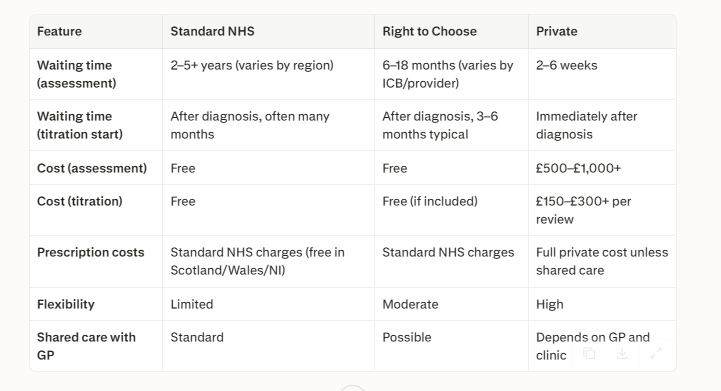
Waiting times for NHS ADHD services vary significantly by region but are often measured in years rather than months. In many areas, waits of 2–5 years for assessment are reported, with titration starting only after diagnosis is complete.
Titration Process
Once you reach the titration stage:
You will start on a low dose of medication
Reviews typically occur every 2–4 weeks during dose adjustment
Titration often takes 3–6 months from first dose to a stable, reviewed dose
Ongoing monitoring occurs every 6–12 months once stable
Costs
Assessment and titration are free under the NHS
You pay standard prescription charges unless exempt (in England; prescriptions are free in Scotland, Wales, and Northern Ireland)
Pros
No direct cost for assessment or titration
Integrated with local services and GP shared care
Suitable for those who can wait and prefer fully NHS-managed care
Cons
Very long waiting times in many regions
Less flexibility in appointment timing and clinician choice
Titration may be delayed due to service capacity
NHS Right to Choose (RTC) Pathway
How It Works
Right to Choose is a legal right in England that allows you to ask your GP to refer you to an NHS-approved independent provider instead of your local NHS waiting list. The assessment is funded by the NHS, and some providers also include titration within their NHS contract.
Waiting Times
Right to Choose waits are typically shorter than standard NHS waits but have increased as demand has grown. Current estimates suggest:
Assessment waits of 6–18 months depending on provider and ICB
Titration, if included, often adds a further 3–6 months
Some ICBs have placed local restrictions on RTC referrals, which can affect availability.
Titration Process
If titration is included in the RTC contract, you will start medication through the same provider
Reviews occur every 2–4 weeks during dose adjustment
If titration is not included, you may need a separate referral to your local NHS service for prescribing
Costs
Assessment and, where included, titration are free under the NHS
Standard prescription charges apply unless exempt
Pros
Faster than standard NHS in most areas
No direct cost to you
Often more flexible appointment options than local NHS services
Cons
Still involves significant waiting times in many regions
Not all providers include titration in their NHS contract
Some ICBs have restricted RTC referrals, limiting options
Private Pathway
How It Works
Private ADHD care involves self-funding your assessment and titration through a private clinic. You book directly, pay upfront, and receive care outside the NHS system. Some private clinics offer shared care agreements with your GP for ongoing prescribing once you are stable.
Waiting Times
Private pathways are typically the fastest:
Assessment often available within 2–6 weeks of booking
Titration can begin immediately after diagnosis
Full titration often completed within 3–6 months
Titration Process
You start on a low dose under the guidance of a private prescriber
Reviews occur every 1–4 weeks during dose adjustment
Once stable, your private clinician may issue a shared care agreement for your GP to take over NHS prescribing (if your GP agrees)
Costs
Private assessment: commonly £500–£1,000+
Private titration: often £150–£300+ per review appointment
Medication costs vary: private prescriptions are paid in full unless shared care is agreed
Pros
Fastest route to assessment and titration
Greater flexibility in appointment timing and clinician choice
Often more frequent reviews and personalised support
Cons
Significant out-of-pocket costs
Shared care with your GP is not guaranteed
Ongoing private titration can become expensive over time
Comparing the Three Pathways
Which Pathway Is Right for You?
The best pathway depends on your priorities:
If cost is the main concern and you can wait, the standard NHS route may be best.
If you want NHS-funded care but faster access, Right to Choose is often the best balance.
If speed and flexibility matter most and you can afford it, private care offers the quickest route.
It is also worth considering your local waiting times, whether your GP supports shared care, and whether you prefer online or in-person appointments.
FAQs: ADHD Titration Pathways in the UK
What is the fastest way to start ADHD titration in the UK?
Private care is typically the fastest, with assessment in 2–6 weeks and titration starting soon after. Right to Choose is faster than standard NHS but still involves months of waiting.
Is Right to Choose available in Scotland, Wales, or Northern Ireland?
No. Right to Choose applies only to NHS England. Other UK nations have separate systems.
Does Right to Choose always include titration?
No. Some providers include titration in their NHS contract; others offer diagnosis only. Always check before accepting a referral.
Can my GP refuse shared care after private titration?
Yes. GPs are not obliged to accept shared care agreements. It is worth discussing this with your GP before starting private treatment.
How long does titration take once started?
Titration typically takes 3–6 months from first dose to a stable, reviewed dose, depending on medication and response.
Are prescription charges the same across all pathways?
In England, standard NHS prescription charges apply for NHS and Right to Choose prescriptions. Private prescriptions are paid in full unless shared care is agreed.
Can I switch pathways during my ADHD journey?
Yes. Some people start privately and later move to NHS shared care, or use Right to Choose and then transition to local NHS services.
If you are struggling with focus, organisation, impulsivity, or emotional regulation, you do not have to navigate it alone. A thorough ADHD assessment is the first step toward understanding your symptoms and exploring treatment options, including safe, supported titration.
At Focus Gently, we are committed to clear, compassionate, and evidence-based ADHD care. From assessment through titration and ongoing support, our goal is to help you move forward with confidence.
Ready to take the next step?
Book your ADHD assessment today at https://www.focusgently.com/ and start your journey toward clearer focus, better organisation, and greater control over your day.