
ADHD traits are behaviours or experiences associated with attention deficit hyperactivity disorder, such as distractibility, forgetfulness, restlessness and impulsivity. An ADHD diagnosis is a clinical conclusion reached when a qualified professional establishes that a person meets recognised diagnostic criteria, experiences significant impairment and does not have a better explanation for the symptom pattern.
Recognising traits can be a valuable starting point. It may help you describe difficulties that have affected your work, relationships or daily routines for years. But recognising yourself in a checklist is not the same as establishing a diagnosis.
This guide explains the difference, what clinicians assess and when it may be worth seeking a professional opinion.
What Are ADHD Traits?
“ADHD traits” is an informal phrase used to describe characteristics commonly associated with ADHD. It is not, by itself, a diagnosis.
Examples include:
Losing focus during tasks or conversations.
Frequently misplacing essential items.
Forgetting appointments or responsibilities.
Struggling to organise activities.
Feeling restless or fidgety.
Talking excessively.
Interrupting or acting without considering consequences.
Someone might say, “I have ADHD traits,” because these experiences feel familiar. That statement does not establish their frequency, developmental history or impact—the details that make clinical assessment important.
The term can also be used loosely online. Not every experience described as an “ADHD trait” corresponds to a formal diagnostic symptom.
What Is an ADHD Diagnosis?
An ADHD diagnosis requires more than a collection of relatable behaviours.
NICE recommends that diagnosis is made by a specialist psychiatrist, paediatrician or another appropriately qualified healthcare professional with training and expertise in ADHD. The assessment should include a full clinical and psychosocial evaluation, developmental and psychiatric history, observer reports and assessment of mental state.
The clinician considers whether symptoms:
Meet recognised diagnostic criteria.
Occur often in at least two important settings.
Cause at least moderate psychological, social, educational or occupational impairment.
Fit the person’s developmental history.
Are better explained by another condition or circumstance.
Diagnosis is therefore an interpretation of the whole clinical picture—not simply a positive questionnaire result.
ADHD Traits vs ADHD Diagnosis: A Comparison
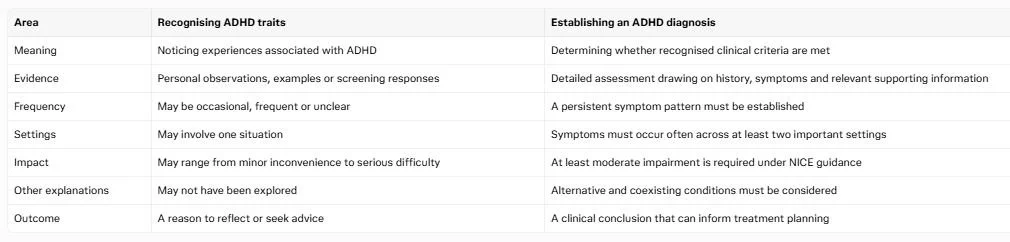
The difference is not whether your experiences are “real”. Both deserve to be taken seriously. The distinction concerns how those experiences are evaluated and whether they meet diagnostic requirements.
Why Relating to Symptoms Is Not Enough
Many ADHD symptoms describe experiences that can occur outside ADHD. Forgetting an appointment or struggling through paperwork does not independently establish a neurodevelopmental condition.
NICE’s evidence review distinguishes ADHD from everyday variation by the combination of high symptom levels and significant, enduring impairment across multiple settings.
Consider two illustrative examples:
One person struggles to focus during a particularly demanding work project but otherwise manages responsibilities.
Another has experienced repeated organisational and attention difficulties since school, affecting employment, home life and relationships.
Neither example provides enough information for diagnosis. However, the second contains more of the developmental and cross-setting pattern clinicians investigate.
A list of familiar traits is useful evidence to discuss—not a substitute for that investigation.
The Importance of Frequency, Persistence and Context
A clinician needs to understand how often difficulties happen and how long they have been present.
The NICE evidence review describes a chronic pattern lasting at least six months, inconsistent with developmental level and impairing functioning across contexts. Current NICE recommendations require symptoms to meet recognised diagnostic criteria.
Useful questions include:
Does this happen most weeks or only occasionally?
Has it persisted through different stages of life?
Does it occur only under particular circumstances?
Is it outside what would be expected for someone of my age?
What practical consequences follow?
Context matters because the same behaviour can have different meanings. Difficulty concentrating in one unusually stressful environment tells a different story from a longstanding pattern across education, employment and home life.
Why Childhood History Matters
ADHD is a neurodevelopmental condition. For adults without a childhood diagnosis, NICE recommends specialist referral where typical manifestations began during childhood, persisted and are associated with moderate or severe impairment.
Assessment may explore:
School experiences and reports.
Repeated feedback about attention or behaviour.
Organisation of homework and belongings.
Relationships with peers.
Support needed to manage routines.
Similar patterns across later education or employment.
You do not need to have been diagnosed as a child to seek assessment as an adult.
Uncertain memories also do not automatically exclude ADHD. NICE specifically advises against exclusion solely because the time of onset is uncertain. The assessor should interpret the available evidence rather than depend on one remembered incident.
What Counts as Significant Impairment?
Impairment means that symptoms interfere meaningfully with functioning. It is different from simply recognising a characteristic.
Examples to discuss might include repeated missed deadlines, persistent problems managing household responsibilities or recurring relationship conflict linked to forgetfulness and interruptions.
NICE considers psychological, social, educational and occupational impairment. Assessment should therefore look beyond academic performance or whether someone holds a job.
For example, a person may function well at work but struggle substantially with home responsibilities. Another may maintain performance while relying on extensive support.
Neither circumstance automatically establishes ADHD. The clinician examines symptoms, consequences, supports and the broader history together.
Why Symptoms Must Occur Across Settings
NICE requires symptoms to occur often in at least two important settings, including family, social, educational or occupational environments.
This helps distinguish a pervasive pattern from a difficulty restricted to one situation.
Relevant information might include:
Attention difficulties at work and during household administration.
Forgetfulness in both education and social commitments.
Impulsive interruptions across professional and family conversations.
The difficulties do not need to look identical everywhere. Different settings have different demands. Assessment should explore the pattern rather than expect a carbon copy of the same behaviour in every environment.
What Else Could Explain ADHD-Like Traits?
A good assessment asks whether ADHD is the best explanation—not merely whether it is possible.
NICE recommends reviewing coexisting conditions, physical health, family and social circumstances, and educational or occupational needs. Adult referral guidance also requires consideration of other psychiatric explanations, while recognising that conditions may coexist.
Tell the clinician about:
Mental-health difficulties.
Sleep and current stress.
Medical conditions and medicines.
Alcohol or other substance use.
Other neurodevelopmental diagnoses.
Recent changes in symptoms or circumstances.
A recent concentration problem should not automatically be interpreted as ADHD. Equally, another diagnosis does not necessarily rule ADHD out.
Can an Online Test Confirm ADHD?
No. Rating scales can support assessment, but NICE states that diagnosis should not be made solely from questionnaire scores or observations.
A screening result may identify symptoms worth discussing. It cannot independently establish developmental history, impairment or whether another explanation is more appropriate.
There is also no specific biological test that independently confirms ADHD. Clinical diagnosis depends on a comprehensive assessment rather than a blood test or brain scan.
For children aged 6–17, NICE allows QbTest as an optional tool to help diagnosis. It remains an aid within the assessment process—not a replacement for clinical evaluation or a general stand-alone adult test.
What Happens During a Professional Assessment?
An assessor gathers information about symptoms and behaviour alongside developmental, medical, educational and mental-health history.
Information may come from the person themselves, parents or carers, schoolteachers or, where appropriate, employers. Interviews, observer reports and standardised rating scales can all contribute.
Preparation can help:
Write down several real-life examples.
Explain how often they occur.
Describe their consequences.
Include examples from different settings.
Note relevant childhood experiences.
List existing conditions, medicines and previous assessments.
You do not need to arrive knowing your presentation or using diagnostic terminology. Honest, specific descriptions are more useful than trying to “prove” ADHD.
What If You Have Traits but Do Not Receive a Diagnosis?
Not receiving an ADHD diagnosis does not mean your difficulties are imaginary or unimportant.
It may mean the full criteria are not met, the available evidence is insufficient or another explanation needs greater consideration. Ask the clinician to explain the conclusion and recommended next steps.
Useful questions include:
Which criteria were and were not met?
Are further investigations appropriate?
What other explanations should be explored?
What support could help with the difficulties identified?
The value of assessment lies in accurate understanding and recommendations—not a guaranteed diagnostic label.
Does a Diagnosis Automatically Mean Medication?
No. Diagnosis and treatment choice are separate decisions.
A diagnosis can inform a personalised plan, but the assessment must also identify the person’s needs, coexisting conditions and circumstances.
Do not assume that assessment guarantees medication, a particular medicine or a transfer of prescribing to your GP.
For example, Focus Gently’s published information explains that medication care involves safety checks and monitoring, while NHS shared care depends on the GP agreeing to participate.
FAQs
Can I have ADHD traits without having ADHD?
Yes. Recognising some traits does not establish the full diagnostic pattern. Frequency, history, impairment, settings and other explanations all matter.
How many traits do I need for a diagnosis?
An informal trait count is not sufficient. Clinicians apply recognised diagnostic criteria within a full assessment, rather than counting items from a general blog checklist.
Can adults receive a first diagnosis?
Yes. NICE provides a referral pathway for adults without a childhood diagnosis when there is evidence of childhood-onset, persistent symptoms associated with significant impairment.
What if I have no school reports?
Tell the assessor what information is available. School records may help, but assessment draws on multiple sources, and uncertainty about onset should not automatically exclude ADHD.
Can I have ADHD if I am not visibly hyperactive?
Yes. ADHD may involve predominantly inattentive difficulties rather than prominent hyperactivity. Assessment considers the recognised symptom pattern.
Is an online assessment valid?
The important questions are who conducts it and whether it is sufficiently comprehensive. Check qualifications, developmental-history assessment, consideration of other conditions and written-report arrangements—not simply whether the appointment is remote.
Book an ADHD Assessment
Move Beyond Recognising Traits. Get a Clearer Understanding.
If attention, organisation, restlessness or impulsivity repeatedly makes daily life harder, you do not have to interpret the pattern alone.
Focus Gently offers comprehensive online adult ADHD assessments with a written report. Its clinician-led service supports assessment, treatment planning and medication care where clinically appropriate for adults in England, Scotland and Wales.focusgently