Differences Between NHS and Private Adult ADHD Assessment Criteria (UK Guide 2026)

If you're an adult in the UK wondering whether to pursue an ADHD assessment through the NHS or privately, you're not alone. With rising awareness of ADHD in adults and growing demand for services, many people find themselves at a crossroads: which route offers the best balance of speed, quality, affordability, and long-term support?
This guide breaks down the key differences between NHS and private adult ADHD assessment criteria, explains what to expect from each pathway, and answers common questions to help you make an informed decision.
What Is an Adult ADHD Assessment?
An adult ADHD assessment is a comprehensive clinical evaluation designed to determine whether an individual meets the diagnostic criteria for Attention-Deficit/Hyperactivity Disorder (ADHD). It is not a simple checklist or screening tool.
A high-quality assessment typically includes:
A detailed clinical interview with a qualified specialist (psychiatrist, psychologist, or other appropriately trained healthcare professional)
Exploration of childhood and adult developmental history
Validated symptom questionnaires (e.g., ASRS, CAARS)
Assessment of functional impairment across work, relationships, and daily life
Screening for co-occurring conditions such as anxiety, depression, autism, or sleep disorders
Application of diagnostic criteria from DSM-5 or ICD-11
Alignment with NICE guidelines (NG87) for ADHD diagnosis and management.
Both NHS and private assessments should follow these standards. However, the pathways, waiting times, and access to ongoing care differ significantly.
NHS Adult ADHD Assessment: Overview
How It Works
The NHS route typically begins with a GP referral. Your GP will assess your symptoms and, if appropriate, refer you to a local NHS ADHD service or community mental health team.
Once referred, you'll undergo a specialist assessment that includes:
A clinical interview (often 45–90 minutes)
Standardised questionnaires
Review of developmental history and current functioning
Evaluation for co-occurring mental health
Strengths of NHS Assessment
Free at the point of care: No direct costs for assessment or treatment.
Integrated care: Diagnosis, medication titration, and ongoing management occur within the NHS system.
Shared care agreements: Post-diagnosis, your GP can usually continue prescribing under a shared care agreement with the specialist service.
NICE-aligned: All assessments follow national clinical guidelines.
Limitations of NHS Assessment
Long waiting times: Depending on your region, waits can range from several months to multiple years.
Limited choice: You're typically assigned to your local service with little control over clinician or appointment format.
Service variability: Some areas have well-resourced ADHD services; others route referrals through general mental health teams, leading to inconsistent experiences.
Private Adult ADHD Assessment: Overview
How It Works
Private assessments allow self-referral, meaning you don't need a GP to initiate the process. You can book directly with a private provider, often completing initial screening forms online before scheduling a clinical interview.
A typical private assessment includes:
A full clinical interview with a GMC-registered psychiatrist or qualified clinician
Structured questionnaires and developmental history review
Screening for co-occurring conditions
A comprehensive diagnostic report with treatment recommendations
Strengths of Private Assessment
Faster access: Most private providers offer assessments within weeks, not months or years.
Flexibility: Choose your provider, appointment format (online or in-person), and timing.
Continuity: Many private services allow you to meet the same clinician throughout the process.
Detailed reporting: High-quality private assessments often provide thorough documentation, which can support shared care with your GP.
Limitations of Private Assessment
Cost: Private assessments typically range from £400 to £1,000+, depending on the provider and what's included.
Shared care uncertainty: Not all GPs accept private diagnoses for ongoing prescribing. Acceptance depends on report quality, adherence to NICE guidelines, and local GP discretion.
Variable quality: Some providers offer rushed or superficial assessments. It's essential to choose a reputable clinic with clear clinical governance.
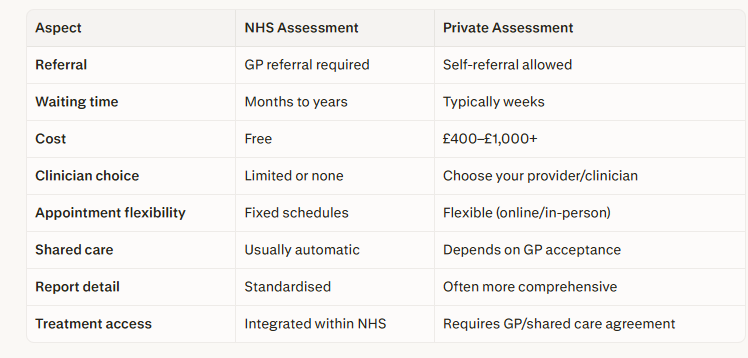
Key Differences: NHS vs Private ADHD Assessment Criteria
While both NHS and private assessments should follow NICE guidelines and DSM-5 criteria, several practical differences affect the patient experience.
What About "Right to Choose"?
In England, adults have a legal right to choose their mental healthcare provider under the NHS. This means you can request a referral to an approved private provider that delivers ADHD assessments under NHS funding.
Right to Choose offers a middle ground:
NHS-funded (no direct cost)
Delivered by approved private providers
Often shorter waiting times than local NHS services
Still requires a GP referral
However, availability varies by region and provider capacity. Not all GPs are familiar with the pathway, and some providers may have limited slots.
Will the NHS Accept a Private ADHD Diagnosis?
This is one of the most common concerns. The short answer: it depends.
Many GPs do accept private ADHD diagnoses, especially when:
The assessment follows NICE guidelines
The report is detailed and includes a clear diagnostic rationale
The clinician is GMC-registered
A titration plan and shared care proposal are included
However, some GPs decline shared care for private assessments, often due to concerns about report quality or lack of familiarity with the provider. To reduce this risk:
Speak to your GP before booking a private assessment
Choose a reputable provider with clear clinical governance
Ensure your assessment includes a full diagnostic report and treatment plan
Frequently Asked Questions (FAQs)
1. How long is the NHS ADHD waiting list?
Waiting times vary widely by region. In many parts of the UK, adult ADHD assessments involve waits of several months to multiple years, depending on local service capacity and demand.
2. Is a private ADHD diagnosis accepted by GPs?
Many GPs do accept private ADHD diagnoses, but shared care depends on report quality, adherence to NICE guidance, and local GP discretion. Acceptance is more likely when assessments are thorough and clearly documented.
3. What is Right to Choose ADHD?
Right to Choose is an NHS pathway in England that allows you to access NHS-funded ADHD assessments delivered by approved private providers. You still need a GP referral, and availability varies.
4. How much does a private ADHD assessment cost?
Private assessment costs vary across the UK. Typical ranges are £400–£1,000+, depending on the provider and what's included (e.g., follow-up appointments, titration support).
5. Can I get medication after a private diagnosis?
Yes. Medication can be prescribed following a private diagnosis, subject to titration by a specialist and shared care arrangements with your GP once treatment is stabilised.
6. Is online ADHD assessment valid in the UK?
Yes. Online ADHD assessments are valid when delivered by qualified clinicians following NICE guidance and recognised diagnostic standards.
7. What happens after diagnosis?
After diagnosis, you should receive a full diagnostic report, clinical letters for your GP or employer, and a treatment plan outlining next steps. Ongoing support may include medication, therapy, or lifestyle strategies.
8. Can the NHS refuse shared care?
Yes. GPs can decline shared care in some cases, particularly if reports lack detail or do not meet expected clinical standards. Discussing shared care with your GP early can reduce this risk.
9. Why is ADHD often diagnosed later in women?
ADHD is often diagnosed later in women because symptoms are more likely to be internalised. Inattention, emotional overload, and chronic mental strain are easier to miss than hyperactivity and are often mistaken for anxiety or stress. Many women reach assessment in adulthood after years of coping without support.
If you've been struggling with symptoms like chronic disorganisation, difficulty focusing, impulsivity, or emotional overwhelm, you don't have to wait years for answers.
Book your ADHD assessment today with a trusted provider that prioritises quality, speed, and long-term support.