Elvanse Strengths Explained: 20 mg to 70 mg Dosing Guide

Elvanse (lisdexamfetamine) is available in the UK as 20 mg, 30 mg, 40 mg, 50 mg, 60 mg, and 70 mg capsules. The right dose is not based on age, weight, or severity alone; clinicians choose it through careful titration, balancing symptom improvement, duration of effect, side effects, and daily functioning.
The usual starting dose is 30 mg once daily in the morning, although 20 mg may be used when a lower starting dose is appropriate. Doses may be increased by 10 mg or 20 mg at approximately weekly intervals, and the maximum recommended dose is 70 mg daily.
This article explains how clinicians approach Elvanse dosing. It is not a self-titration guide. Do not change your dose without advice from your prescriber.
How Elvanse Works
Elvanse contains lisdexamfetamine, a prodrug that is converted in the body into dexamfetamine. Because it is converted gradually, it is designed to provide longer-lasting ADHD symptom control from a once-daily morning dose.
The aim of treatment is not to make someone feel “wired” or euphoric. It is to improve functioning—such as attention, task initiation, organisation, impulse control, emotional regulation, and the ability to manage school, work, or home responsibilities.
A dose is working well when it improves the symptoms that matter to the person while keeping side effects manageable.
What Strengths Are Available?
In the UK, Elvanse is available as:
20 mg capsules
30 mg capsules
40 mg capsules
50 mg capsules
60 mg capsules
70 mg capsules
The availability of individual strengths can change over time. During previous supply disruptions, some strengths were affected more than others, and services were advised to consider using a 30 mg, 50 mg, and 70 mg titration schedule where possible.
This does not mean those are the only clinically useful doses. It means that supply, formulation availability, and local prescribing arrangements can influence how titration is carried out.
Why Does Dose Not Depend Only on Weight?
Unlike some medicines, Elvanse dosing is not calculated simply by body weight.
Two people of the same weight may need very different doses because ADHD symptoms, metabolism, sensitivity to stimulants, sleep, anxiety, coexisting conditions, and daily demands all affect response.
A clinician may consider:
Severity of inattention, impulsivity, and hyperactivity.
How much impairment ADHD causes at home, school, university, work, or while driving.
Duration of symptom control needed.
Appetite, sleep, mood, and anxiety.
Blood pressure and pulse.
Previous response to methylphenidate or other ADHD medicines.
Risk of misuse, diversion, or accidental overuse.
Other medicines and health conditions.
Patient preference.
The licensed product information advises using the lowest effective dose and increasing it only as needed.
Starting Dose: 20 mg or 30 mg?
Usual starting dose: 30 mg
For most eligible patients, the usual starting dose is 30 mg once daily in the morning. This is the standard starting point in the licensed product information and is commonly used in UK prescribing frameworks.
When 20 mg may be used
A 20 mg starting dose may be considered when a clinician judges that a lower initial dose is appropriate. This may include people who are sensitive to stimulant side effects or who have particular clinical concerns.
A lower starting dose does not mean the medicine is weaker or less effective. It may simply be a safer or more tolerable way to begin treatment.
Why not start at 70 mg?
Starting at the maximum dose is generally not appropriate because it increases the chance of side effects and makes it harder to identify the lowest effective dose. Titration allows the clinician to find the smallest dose that provides meaningful benefit.
How Does Titration Work?
Titration is the process of adjusting the dose gradually to find the best balance between benefit and tolerability.
The licensed UK information states that the dose may be increased by 10 mg or 20 mg increments at approximately weekly intervals. The maximum recommended dose is 70 mg daily.
A typical approach may look like this:
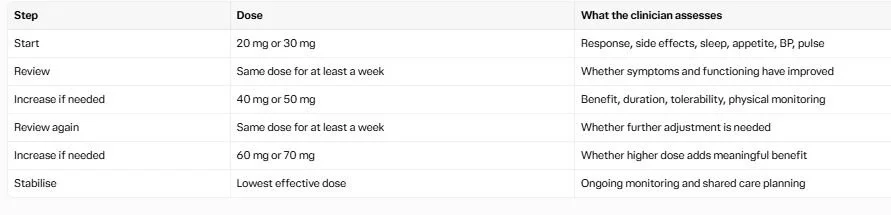
The exact sequence depends on the starting dose, available strengths, response, and local protocol. For example, a person starting at 30 mg may move to 50 mg, then 70 mg if needed; another may move in 10 mg steps if finer adjustment is needed.
What Does Each Strength Do?
There is no fixed “20 mg is for mild ADHD, 70 mg is for severe ADHD” rule. However, clinicians may use higher doses when lower doses do not provide enough symptom control or duration.
20 mg
This is often used as a cautious starting dose. It may suit people who are sensitive to stimulants or who need a gentler introduction to treatment.
30 mg
This is the usual starting dose. Many people find it provides useful improvement in attention, task initiation, and impulse control.
40 mg
This may be used when 20 mg or 30 mg provides some benefit but symptoms or duration of effect remain insufficient. It can also be useful when a clinician wants a smaller step up from 30 mg.
50 mg
This is a common next step after 30 mg, particularly when using a 30 mg, 50 mg, and 70 mg titration schedule. It may provide stronger or longer symptom control for some people.
60 mg
This may be used when 50 mg is helpful but not enough, or when a clinician wants a smaller increase before moving to 70 mg. It may also be useful for fine-tuning treatment in people who are sensitive to dose changes.
70 mg
This is the maximum recommended daily dose. It may be considered when lower doses have not provided enough benefit and side effects remain acceptable. Higher doses have not been studied in the licensed product information.
How Long Does Each Dose Last?
Elvanse is designed to provide extended coverage from a once-daily morning dose. In clinical studies, effects were observed to continue for up to 13 hours in children and 14 hours in adults, although individual duration varies.
A higher dose does not always mean a proportionally longer duration. It may provide stronger symptom control, but the duration depends on the person, dose, metabolism, and daily routine.
If medication wears off too early, a clinician may consider:
Checking adherence and timing.
Reviewing sleep, stress, and other medicines.
Increasing the dose if appropriate.
Considering a different ADHD medicine.
Reviewing whether a shorter-acting medicine may be more suitable.
If medication lasts too long and affects sleep or appetite, a lower dose, earlier timing, or alternative treatment may be considered.
How Clinicians Assess Whether a Dose Is Right
A dose is not “right” simply because symptoms improve. It is right when the overall balance is acceptable.
Clinicians assess:
Symptom control
Can the person start and sustain tasks?
Is distractibility reduced?
Is impulsivity better managed?
Are routines easier to follow?
Is emotional regulation improved?
Functioning
Is school, university, or work performance improving?
Are deadlines, chores, or self-care easier to manage?
Is driving safer?
Are relationships less strained?
Is the person able to do what matters to them?
Side effects
Is appetite acceptable?
Is weight stable?
Is sleep affected?
Is anxiety or irritability worse?
Are there palpitations, chest pain, or headaches?
Are tics worsening?
Is mood stable?
Physical monitoring
Blood pressure.
Pulse.
Weight.
Height and growth in children and adolescents.
Cardiovascular history and symptoms.
NICE recommends recording symptoms, impairment, and adverse effects at baseline and at each dose change. Medication should be reviewed at least annually once established.
What If a Dose Is Too Low?
Signs that a dose may be too low include:
Little or no improvement in attention or impulsivity.
Symptoms still significantly affecting school, work, or home life.
Medication wearing off too early.
The person feels no meaningful difference.
Functioning has not improved despite taking the medicine as prescribed.
Before increasing the dose, the clinician should check:
Is the medicine being taken consistently?
Is it being taken at the right time?
Are there sleep problems, stress, or other conditions affecting symptoms?
Could a coexisting condition be contributing?
Are there practical barriers such as difficulty swallowing capsules or accessing medication?
If the dose is increased, the clinician should reassess benefit and side effects before making further changes.
What If a Dose Is Too High?
Signs that a dose may be too high include:
Significant appetite loss or weight loss.
Difficulty sleeping.
Anxiety, agitation, or irritability.
Feeling emotionally flat or overstimulated.
Palpitations or raised blood pressure.
Worsening tics.
Reduced enjoyment of usual activities.
A “crash” or rebound when the medication wears off.
If these occur, the prescriber may reduce the dose, change the timing, review other medicines, consider a treatment break, or consider an alternative ADHD medicine.
Do not reduce or stop Elvanse on your own. The licensed information states that if paradoxical worsening of symptoms or intolerable adverse events occur, the dose should be reduced or treatment discontinued under clinical guidance.
What If 70 mg Is Not Enough?
If 70 mg does not provide enough benefit, the prescriber should review the whole treatment plan rather than simply exceeding the licensed maximum.
They may consider:
Whether the diagnosis is correct.
Whether another condition is contributing, such as anxiety, depression, sleep problems, autism, or trauma.
Whether the medicine is being taken consistently.
Whether another stimulant or non-stimulant may be more suitable.
Whether psychological, educational, occupational, or behavioural support is needed.
Whether a different formulation or medicine may provide better duration or tolerability.
The maximum recommended dose is 70 mg daily, and higher doses have not been studied in the licensed product information.
FAQs
What is the usual starting dose of Elvanse?
The usual starting dose is 30 mg once daily in the morning. A 20 mg starting dose may be used when a lower starting dose is clinically appropriate.
How often can the dose be increased?
The dose may be increased by 10 mg or 20 mg at approximately weekly intervals, depending on response and tolerability.
What is the maximum dose?
The maximum recommended dose is 70 mg once daily. Higher doses have not been studied in the licensed product information.
Does a higher dose mean better focus?
Not necessarily. A higher dose may improve symptoms for some people, but it can also increase side effects. The best dose is the one that improves functioning with acceptable tolerability.
Can I take two lower-strength capsules instead of one higher-strength capsule?
Only if your prescriber specifically instructs you to. Do not combine capsules or adjust doses yourself.
Why did my clinician start me on 20 mg instead of 30 mg?
A lower starting dose may be chosen if you are sensitive to stimulant side effects or if your clinician judges it appropriate for your circumstances.
What if 30 mg helps but wears off too early?
Do not increase the dose yourself. Contact your prescriber. They may review timing, adherence, sleep, other medicines, and whether a dose increase or alternative treatment is appropriate.
Can I switch from 50 mg to 40 mg if side effects are troublesome?
Possibly, but only with prescriber advice. A dose reduction may improve side effects but may also reduce symptom control.
How long does it take to find the right dose?
It varies. Some people respond well at the starting dose, while others need several weeks of careful titration. The aim is to find the lowest effective dose that provides meaningful benefit.
Book an ADHD Assessment
Finding the right Elvanse dose starts with a clear understanding of your ADHD symptoms, daily challenges, health history, and treatment goals.
Focus Gently offers ADHD assessments that explore:
Symptoms across home, work, study, and relationships.
Developmental and clinical history.
Functional impairment.
Coexisting anxiety, depression, sleep problems, or neurodevelopmental conditions.
Medication history and treatment preferences.
Personalised recommendations for medication and non-medication support.
You do not have to keep adjusting medication on your own or wondering whether your symptoms are being managed effectively.