How to Track Symptoms to Share with a Clinician During an ADHD Assessment (UK Guide 2026)

How to Track Symptoms to Share with a Clinician During an Assessment
If you're preparing for an adult ADHD assessment, you've probably been told to "track your symptoms." But what does that actually mean? And how do you make sure the information you share is useful, accurate, and Clinician-ready?
The truth is: symptom tracking can make or break your assessment. A well-organised symptom log gives your clinician concrete evidence of how ADHD affects your daily life, helps distinguish ADHD from other conditions, and speeds up the diagnostic process.
This guide walks you through exactly how to track your symptoms, what tools to use, and how to present your findings so your clinician can make the most informed diagnosis possible.
Why Symptom Tracking Matters
ADHD isn't diagnosed through blood tests or brain scans. Instead, clinicians rely on:
Your self-reported symptoms and history
Evidence of functional impairment across multiple areas of life
Corroboration that symptoms began in childhood and persist into adulthood
Ruling out other conditions that may mimic ADHD (e.g., anxiety, depression, sleep disorders)
Symptom tracking helps you:
Provide specific, real-world examples instead of vague descriptions
Show patterns over time (e.g., "I forget appointments 3–4 times per week")
Highlight which symptoms cause the most impairment
Identify triggers, coping strategies, and situations where symptoms worsen
Demonstrate that your struggles aren't just "bad days" but consistent challenges
In short: good symptom tracking = better diagnosis.
What to Track: The Core ADHD Symptom Domains
ADHD symptoms fall into two main categories: inattention and hyperactivity-impulsivity. Most adults experience a mix of both, though one may dominate.
Inattention Symptoms to Track
Difficulty sustaining attention during tasks, meetings, or conversations
Making careless mistakes or overlooking details
Starting tasks but not finishing them
Losing or misplacing things (keys, phone, documents)
Forgetting appointments, deadlines, or daily responsibilities
Avoiding tasks that require sustained mental effort
Getting easily distracted by thoughts, noises, or notifications
Feeling mentally "foggy" or overwhelmed
Hyperactivity-Impulsivity Symptoms to Track
Feeling restless or "on the go" internally
Fidgeting, tapping, or needing to move constantly
Talking excessively or interrupting others
Difficulty waiting your turn (e.g., in queues or conversations)
Acting on impulse (e.g., spending, eating, making decisions) without thinking
Starting multiple projects but struggling to complete any
Feeling easily bored or needing constant stimulation
Functional Impairment to Document
Beyond symptoms, track how they affect your life:
Work: Missed deadlines, unfinished projects, difficulty prioritising
Relationships: Forgetting plans, interrupting, emotional dysregulation
Daily life: Late bills, messy home, forgotten appointments
Self-care: Irregular meals, poor sleep, neglected health
Emotional health: Frustration, shame, overwhelm, burnout
How to Track Symptoms: Practical Methods
You don't need fancy apps or expensive tools. The key is consistency and specificity. Here are several proven methods:
1. Daily Symptom Journal (Pen & Paper or Digital)
What to do: Each day, note:
Which symptoms you experienced
How often they occurred (e.g., "3 times today")
Specific examples (e.g., "Forgot to send important email, missed deadline")
Impact on your day (e.g., "Felt stressed, had to work late")
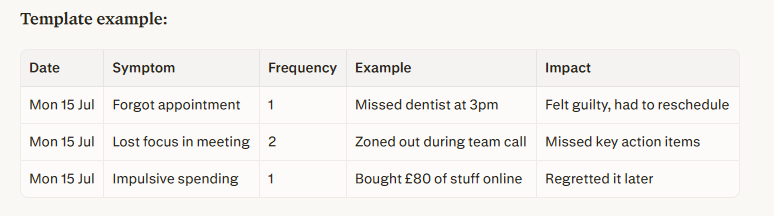
Pros: Flexible, personalised, easy to review with your clinician.
Cons: Requires daily effort; can feel overwhelming if you're already struggling.
2. Weekly Symptom Summary
If daily tracking feels too much, try a weekly review. At the end of each week, reflect on:
Which symptoms were most frequent
Specific incidents that stood out
Patterns (e.g., "I forget more on busy days" or "I impulse-spend when stressed")
Template example:
Week of 15–21 July 2026
Inattention: Forgot 2 appointments, lost keys 3 times, struggled to finish 1 work report
Hyperactivity: Felt restless during meetings, interrupted partner twice
Impulsivity: Spent £150 on unnecessary items online
Emotional impact: Felt frustrated and ashamed; avoided social plans because I was overwhelmed
Pros: Less time-consuming; still provides useful patterns.
Cons: Less detailed than daily tracking; relies on memory.
3. Use Validated Rating Scales
Many clinicians use standardised tools like the Adult ADHD Self-Report Scale (ASRS) or Conners' Adult ADHD Rating Scales (CAARS). You can use these yourself to track symptoms over time.
How to use:
Download a free ASRS checklist online
Complete it weekly or monthly
Note which items you endorsed and any changes over time
Example ASRS items:
"How often do you have trouble wrapping up the final details of a project, once the challenging parts have been done?"
"How often do you have difficulty getting things in order when you have to do a task that requires organisation?"
Rate each on a scale from "Never" to "Very Often."
Pros: Clinician-friendly; aligns with diagnostic criteria.
Cons: Less contextual detail than journals.
4. Digital Tools & Apps
If you prefer tech, try:
Notion or Google Docs: Create a symptom tracker template
Habitica or Todoist: Track task completion and note where you struggle
Mood tracking apps (e.g., Daylio, Sanvello): Log mood alongside symptoms
Spreadsheets: Build a simple tracker with columns for date, symptom, frequency, impact
Pros: Easy to search, share, and visualise patterns.
Cons: Can become another thing to manage if you're already overwhelmed.
5. Collateral Evidence
Where possible, gather supporting evidence:
Old school reports: Look for comments like "bright but doesn't apply himself" or "talks too much in class"
Partner or family input: Ask someone close to you to note observations (e.g., "You often forget plans" or "You seem restless during movies")
Work feedback: Performance reviews mentioning missed deadlines, disorganisation, or difficulty focusing
Medical records: Previous mental health assessments, therapy notes, or prescriptions
Pros: Provides objective corroboration of childhood symptoms and current impairment.
Cons: Not always available; may require asking others for input.
How Long Should You Track?
There's no hard rule, but here's a practical guideline:
Minimum: 2–4 weeks of tracking before your assessment
Ideal: 1–3 months to show consistent patterns
If you're short on time: Even 1–2 weeks of detailed tracking is better than nothing
The goal isn't perfection—it's to show patterns over time rather than isolated incidents.
How to Present Your Symptom Log to Your Clinician
Once you've tracked your symptoms, organise them so your clinician can quickly understand your profile.
1. Create a Summary Sheet
Before your appointment, write a one-page summary highlighting:
Your top 3–5 most impairing symptoms
Specific examples (e.g., "I've missed 4 work deadlines in the past 2 months")
Any patterns you've noticed (e.g., "Symptoms worsen when I'm stressed or sleep-deprived")
How symptoms affect different areas of life (work, relationships, self-care)
Example:
Top Symptoms:
Forgetting appointments (3–4 times/month)
Starting tasks but not finishing them (daily)
Impulsive spending (£200–£400/month)
Impact:
Work: Missed 2 deadlines in past month; manager raised concerns
Relationships: Partner frustrated I forget plans
Finances: Overspending causing stress
Patterns:
Worse when sleep <6 hours
Better when I use reminders and lists
2. Bring Your Full Log (Digital or Printed)
Your clinician may want to see your full tracking log. Have it ready in a format they can review:
Printed journal or spreadsheet
Shared Google Doc or Notion page
PDF export of your tracker
3. Be Honest, Not Perfect
Don't try to "perform" ADHD or exaggerate symptoms. Clinicians are trained to spot inconsistency. Instead:
Be honest about what you experience
Acknowledge coping strategies you've developed
Note any days when symptoms are better or worse
Common Mistakes to Avoid
❌ Vague Descriptions
Bad: "I have trouble focusing."
Good: "I lose focus during meetings 2–3 times per week. Last week, I zoned out during a 30-minute team call and missed key action items."
❌ Only Tracking "Bad Days"
Track symptoms consistently, not just when things go wrong. This helps show whether struggles are occasional or persistent.
❌ Forgetting to Note Coping Strategies
If you've developed workarounds (e.g., alarms, lists, reminders), mention them. Clinicians need to know whether symptoms persist despite compensation.
❌ Over-Tracking and Burning Out
If daily journaling feels overwhelming, scale back. Weekly summaries or validated scales are equally valid.
Frequently Asked Questions (FAQs)
1. How far back should I track symptoms?
Track current symptoms for at least 2–4 weeks before your assessment. For childhood history, try to recall or gather evidence (e.g., school reports, parental input) of symptoms before age 12.
2. Do I need to track every day?
No. Weekly summaries or even bi-weekly check-ins are acceptable. The key is showing consistent patterns over time, not perfect daily logs.
3. What if I don't have childhood records?
You can still be diagnosed without school reports. Clinicians rely heavily on your self-report, current functioning, and evidence of childhood symptoms (even if not formally recognised at the time).
4. Should I track mood alongside ADHD symptoms?
Yes. Mood, sleep, and stress levels can affect ADHD symptoms. Noting these helps clinicians rule out or identify co-occurring conditions like anxiety or depression.
5. Can I use apps to track symptoms?
Absolutely. Apps, spreadsheets, or digital documents are fine as long as they capture specific symptoms, frequency, and impact.
6. What if my symptoms vary a lot?
That's normal. Note patterns (e.g., "worse when stressed" or "better on weekends"). Variability doesn't rule out ADHD.
7. How detailed should my examples be?
Specific but concise. Instead of "I forget things," write "I forgot to submit my timesheet 3 times this month, causing payroll delays.”
8. Can I track symptoms after my assessment?
Yes. Ongoing tracking can help monitor treatment response, medication effectiveness, and lifestyle adjustments. Many people continue symptom logs post-diagnosis.
9. What if I'm already seeing a therapist or psychiatrist?
Share your symptom log with them. It can inform treatment planning and help distinguish ADHD from other conditions.
Ready to Take the Next Step?
Tracking your symptoms is one of the most powerful things you can do before an ADHD assessment. It transforms vague frustrations into concrete evidence—and gives your clinician the clarity they need to make an accurate diagnosis.
But you don't have to do it alone.
🚀 Why Choose Focus Gently?
Expert guidance: Our clinicians help you understand what to track and how to present it.
Comprehensive assessments: All evaluations follow NICE guidelines and DSM-5 criteria.
Personalised support: We don't just diagnose—we help you understand your brain and build a plan that works.
Flexible options: Online or in-person appointments to suit your schedule.
Fast access: Get assessed within weeks, not months or years.
Book an ADHD Assessment at Focus Gently.