Private ADHD Assessment: 10 Questions to Ask Before Booking

A private ADHD assessment can be a positive step toward answers, support and treatment. But before you book, it is worth asking the right questions about the clinician, assessment process, report, costs and what happens after diagnosis.
The best private ADHD assessment is not necessarily the quickest appointment or the lowest headline price. It is a thorough, clinically sound process that considers your whole history and gives you a realistic plan for what happens next.
In the UK, a proper ADHD diagnosis should be based on a full clinical and psychosocial assessment, a developmental and psychiatric history, observer information where available, and an assessment of your mental state. A questionnaire alone is not enough.
This guide gives you 10 practical questions to ask before booking a private ADHD assessment, plus the warning signs to avoid and the steps to take if you already have a diagnosis but your treatment pathway has stalled.
1. Who will carry out my ADHD assessment?
The first question to ask is simple: Who is the clinician assessing me?
You should know the person’s professional role, registration and experience in adult ADHD before paying for an appointment. ADHD diagnosis should be carried out by an appropriately qualified clinician with training and expertise in ADHD assessment.
Ask the provider:
What is the assessor’s job title and professional registration?
What experience do they have in adult ADHD?
Do they assess both inattentive and hyperactive-impulsive presentations?
Do they have experience with ADHD in women, high-masking adults and later-life diagnosis?
Will I speak to the same clinician throughout the assessment process?
Who will provide feedback and discuss treatment options?
A reputable provider should answer these questions clearly. Be cautious if a service gives vague information about who will assess you or presents generic marketing without identifying the clinical team.
2. Is the assessment comprehensive?
A private ADHD assessment should be more than a symptom questionnaire or a short conversation about concentration. ADHD is a neurodevelopmental condition, so the clinician needs to understand your experiences across childhood and adulthood.
A comprehensive assessment should usually include:
Current ADHD symptoms.
Childhood and developmental history.
Education, work, home and relationship impact.
Mental-health history.
Physical-health history.
Sleep, alcohol, substance use and medication review.
Possible coexisting conditions.
Functional impairment in more than one setting.
Observer or informant information where available.
Ask how the assessment is structured and what evidence the clinician considers. If a provider cannot explain how they assess childhood onset, impairment and alternative explanations, it may not offer the depth needed for a reliable diagnosis.
3. How do you assess childhood ADHD symptoms?
ADHD symptoms should have been present in childhood, even if no one recognised them at the time. That does not mean you need a perfect school record or a parent who remembers every detail, but it does mean the clinician should explore your early experiences carefully.
Ask:
Will you discuss my school years and childhood behaviour?
Can I submit school reports, educational records or old assessments?
Do you ask for an informant questionnaire from a parent, sibling, partner or friend?
What happens if I do not have school reports or contact with family?
How do you assess childhood symptoms in women or people who masked heavily?
Relevant childhood patterns may include daydreaming, inconsistent work, lost belongings, forgotten homework, restlessness, impulsivity, social difficulties, excessive talking, emotional outbursts or being described as “bright but not trying.”
A thorough clinician will use available evidence and clinical judgement. They should not expect a flawless paper trail.
4. How will you assess coexisting conditions?
Many adults who seek an ADHD assessment also experience anxiety, depression, autism traits, trauma symptoms, sleep difficulties, chronic pain, learning differences or substance-use concerns.
These conditions can overlap with ADHD, exist alongside it or sometimes better explain attention difficulties. This is why a proper assessment should look beyond a checklist.
Ask:
How do you distinguish ADHD from anxiety or depression?
Will you consider autism, dyslexia, dyspraxia or other neurodevelopmental conditions?
Do you ask about trauma, sleep and physical health?
What happens if you think another condition needs support?
Can you recommend a referral, therapy or further assessment?
A good clinician should neither dismiss your ADHD concerns because you have anxiety nor assume every difficulty is ADHD. They should explain how they reached their conclusions and what support is needed next.
5. Will I receive a detailed written report?
Always ask whether you will receive a full diagnostic report and what it includes. A brief confirmation letter may not be enough if you later need medication, workplace adjustments, university support, a shared-care request or a transfer to another ADHD service.
A detailed report should normally cover:
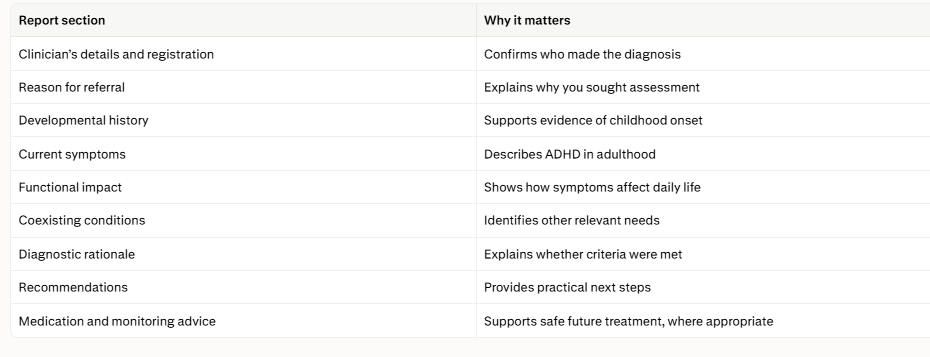
Ask when you will receive the report, whether feedback is included in the assessment price and whether the provider can write to your GP with your consent.
6. What does the advertised price actually include?
The initial price may not reflect the full cost of private ADHD care. Before booking, ask for a clear written breakdown.
Clarify whether the fee includes:
Pre-assessment questionnaires.
Informant forms.
The clinical appointment.
Diagnostic feedback.
A full written report.
A letter to your GP.
Administrative or prescription fees.
Follow-up questions after diagnosis.
Supporting letters for work, university or Disabled Students’ Allowance.
A second appointment if the clinician needs more information.
It is reasonable to compare prices, but compare the complete service—not only the headline figure. A lower-cost assessment that does not include a detailed report, clinical feedback or support after diagnosis may cost more in the long run.
7. What happens if medication is appropriate?
Medication can be highly helpful for some adults with ADHD, but it is not automatic and should only be considered after a full assessment and safety review.
Ask:
Does the clinic provide medication assessment and titration?
Who prescribes medication?
What physical checks are required before treatment?
How often are reviews during titration?
What do reviews, prescriptions and medication cost?
What happens if the first medication is not suitable?
How will side effects, sleep, appetite, mood, blood pressure and pulse be monitored?
Is there a plan for annual reviews once treatment is stable?
Medication initiation and dose adjustment should be structured and monitored. Shared-care arrangements generally expect the specialist to assess, initiate treatment, stabilise the medication and remain involved in ongoing specialist review.
A provider should never guarantee medication before assessing you. The right treatment depends on your diagnosis, medical history, mental health, other medicines and treatment goals.
8. Do you offer continuity of care after diagnosis?
A diagnosis can be life-changing, but it should not be the end of the service. Before booking, ask what support is available after your report is issued.
Useful post-diagnosis support may include:
A feedback consultation.
Medication discussion and titration, if appropriate.
Ongoing medication reviews.
ADHD education.
Coaching, therapy or practical strategy recommendations.
Support for workplace or study adjustments.
Help with coexisting conditions.
Referral or signposting to other services.
Ask whether you will have continuity with the same clinician or whether your care will be transferred after diagnosis. This matters if you need treatment adjustments, a medication review, a GP letter or support after your circumstances change.
9. Will you support shared care with my GP?
Shared care is an arrangement in which a specialist and GP agree how prescribing and monitoring will be managed after ADHD medication has been started and stabilised. It can make ongoing prescriptions more accessible, but it is never guaranteed.
Ask:
Do you provide formal shared-care documentation?
Will you write directly to my GP?
What information do you give the GP about diagnosis, titration and monitoring?
Do you remain available for annual reviews and treatment advice?
What happens if my GP asks questions or needs more evidence?
What happens if my GP declines shared care?
GPs are not automatically required to accept private shared-care requests. They retain professional responsibility for any prescription they issue, and local NHS or practice policies may affect whether they can take on prescribing.
Some practices require the diagnosis to be made by an appropriate specialist, require medication to be stable before considering shared care, and require the private clinician to remain responsible for specialist review.
Avoid any provider that promises your GP will prescribe. They cannot make that promise on a GP’s behalf.
10. What happens if my GP declines shared care or my care stalls?
This is one of the most important questions because a declined shared-care request can leave people uncertain about treatment costs and continuity.
Ask the provider:
Can you continue prescriptions and monitoring privately?
What will that cost?
How quickly can I access a follow-up?
Will I receive copies of all reports, titration records and monitoring results?
Can you provide a handover summary if I later transfer services?
What happens if the clinician leaves or the clinic changes its service?
If you already have a documented diagnosis but your previous provider has stopped offering follow-up, you cannot complete titration, your review appointments have lapsed or your GP has declined shared care, Focus Gently may be able to help.
Focus Gently provides CQC-regulated, remote adult ADHD assessments, treatment planning, medication initiation and titration where clinically appropriate. Its ADHD titration pathway is also designed for adults with a confirmed diagnosis who need continuity after another care pathway has stalled. The service is led by a specialist clinician and includes records review, medication monitoring and support with GP communication where appropriate.
Red flags to look out for
A private ADHD assessment should feel clinically robust and transparent. Consider looking elsewhere if a provider:
Guarantees a diagnosis.
Diagnoses you from a questionnaire alone.
Cannot tell you who will assess you.
Does not explore childhood history.
Does not ask about daily impairment.
Ignores anxiety, trauma, sleep, substance use or physical health.
Guarantees medication before assessment.
Promises that your GP will accept shared care.
Does not provide a detailed report.
Cannot explain ongoing costs.
Offers no pathway for follow-up or treatment review.
Private care should give you more clarity and choice—not pressure you into an unclear process.
How to prepare once you book
You do not need to create a perfect evidence pack. The goal is to provide useful context, not prove your case beyond doubt.
Consider preparing:
School reports, if available.
Previous mental-health or neurodevelopmental reports.
A list of current medicines, supplements and health conditions.
Relevant medical letters.
A short timeline of childhood, teenage and adult difficulties.
Examples of how symptoms affect work, study, home life, relationships and finances.
Contact details for an informant, if requested.
Be honest about both your struggles and your strengths. The clinician needs to know how you cope, what support you rely on and what it costs you emotionally or practically to maintain that coping.
Frequently asked questions
Is a private ADHD assessment valid in the UK?
Yes, if it is completed by an appropriately qualified clinician using a comprehensive assessment process. NICE quality standards state that diagnosis should be based on a full clinical and psychosocial assessment, developmental and psychiatric history, observer information where available and mental-state assessment.
How long does a private ADHD assessment take?
It varies between providers and depends on the complexity of your history. Ask the provider how much appointment time is included and how they allow for childhood history, symptom review, functional impairment, coexisting conditions and feedback.
Do I need school reports?
No. School reports can support evidence of childhood symptoms, but they are not essential. A clinician can use your developmental history, informant information, other relevant records and clinical judgement.
Can I get medication straight after a private ADHD assessment?
Not necessarily. Medication should be considered only when a diagnosis is confirmed and the clinician has reviewed safety factors, medical history and your needs. If medication is appropriate, it may be started and adjusted through a monitored titration process.
Will my GP prescribe after a private diagnosis?
Possibly, but it is not guaranteed. Your GP must agree to any shared-care arrangement and be satisfied that the diagnosis, medication plan, specialist input and monitoring arrangements are safe and appropriate.
What should I do if shared care is refused?
Ask your GP for the reason, discuss it with your specialist provider and request copies of your diagnostic report, treatment plan, titration notes and monitoring records. You may need to continue private care, explore an NHS pathway or seek a provider that can offer safe ongoing support.
Book an ADHD Assessment
You do not have to keep struggling without answers—or spend more time navigating unclear private-care pathways.
Book an ADHD assessment with Focus Gently for a CQC-regulated, virtual adult ADHD assessment with clear diagnostic feedback, treatment planning and follow-up support. Where clinically appropriate, Focus Gently can support medication initiation, titration and monitoring, with communication to your GP as needed.
If you already have an ADHD diagnosis but your treatment pathway has stalled, Focus Gently can also review your existing records to see whether ongoing titration and medication support may be appropriate. Start with the online screener or book the appointment that fits your current stage of care.