Private ADHD Prescribing UK 2026: Complete Guide to Costs, Process & Shared Care

For thousands of adults across the UK, private ADHD prescribing has become a lifeline — bypassing NHS waiting lists that can stretch from 18 months to over three years. The rise in private ADHD treatment has been dramatic: in Northern Ireland alone, private ADHD prescriptions jumped from just 6 in 2019 to nearly 4,000 in 2024.
However, going private for ADHD treatment involves significant financial commitments, complex decisions about shared care agreements, and important considerations that many patients don't fully understand before starting. This comprehensive guide covers everything you need to know about private ADHD prescribing in the UK in 2026, from costs and processes to the realities of GP acceptance and long-term treatment planning.
Why Are People Choosing Private ADHD Prescribing?
The NHS Waiting List Crisis
The primary driver behind the surge in private ADHD prescribing is the unacceptable waiting times for NHS assessment and treatment. Many NHS trusts have waiting lists exceeding 18 months to 3+ years, with some regions experiencing even longer delays. The Department of Health acknowledges these waiting times as unacceptable, yet the situation shows little improvement.
Speed of Access
Private ADHD assessments can typically be booked within 1–3 weeks, compared to years on NHS waiting lists. For adults whose ADHD is affecting their employment, relationships, and mental health, this speed difference is often the deciding factor.
Control Over Your Treatment
Private prescribing gives you:
Choice of specialist psychiatrist
More appointment time and flexibility
Direct access to medication titration
Video consultations available UK-wide
Personalized treatment plans without regional restrictions
The Private ADHD Prescribing Process: Step-by-Step
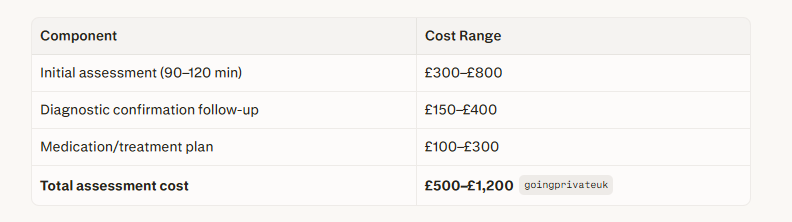
Step 1: Initial Assessment (£300–£800)
Your first appointment is typically 90–120 minutes and includes:
Comprehensive ADHD symptom evaluation
Childhood history review (report cards, parent/sibling interviews)
Assessment of current functional impairment
Screening for comorbid conditions (anxiety, depression, substance use)
Physical health screening (blood pressure, heart rate)
Step 2: Diagnostic Confirmation (£150–£400)
Many clinics require a follow-up appointment to:
Confirm diagnosis against NICE guidelines
Discuss assessment results
Review any additional testing or questionnaires
Make final diagnostic determination
Step 3: Medication Titration (£100–£300 per follow-up)
If medication is appropriate, you'll enter a titration phase:
Starting with lowest effective dose
Regular follow-ups every 2–4 weeks
Dose adjustments based on response and side effects
Monitoring of cardiovascular health
Typically 8–12 weeks to reach stable dose
Step 4: Maintenance or Shared Care Agreement
Once stabilized, you have two options:
Option A: Continue Full Private Care
Monthly prescriptions privately
Regular private follow-ups (usually every 3–6 months)
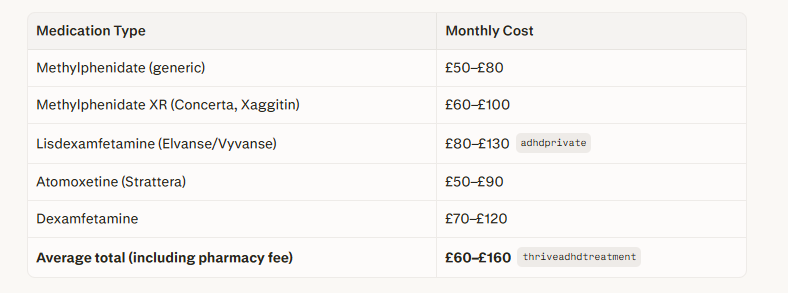
Ongoing costs: £50–£160 per month for medication + £50–£150 per review
Option B: Transfer to NHS Shared Care
Private clinic sends detailed report to GP
GP agrees to prescribe at stabilized dose under NHS rates
You pay standard NHS prescription charges (£9.90 per item in England or free with exemptions)
Private clinic monitors annually or as needed
Understanding Shared Care Agreements: The Critical Detail
What Is a Shared Care Agreement?
A Shared Care Agreement (SCA) is a formal arrangement where:
Your private psychiatrist stabilizes your medication
Your NHS GP agrees to prescribe at NHS rates
The private clinic retains clinical responsibility for ADHD treatment
You pay only NHS prescription costs instead of full private prices
The Reality Check: Not All GPs Accept Shared Care
This is the most important consideration before going private:
Your GP has the right to refuse to prescribe ADHD medication on the NHS if you paid for a private assessment
Some practices have explicit policies refusing shared care for privately diagnosed patients
172 out of 197 private clinics offer shared care agreements, but GP acceptance is not guaranteed
NHS clinicians cannot be compelled to accept a private diagnosis and may disagree with it
Factors Affecting GP Acceptance
More likely to accept shared care:
Clinics using NHS Right to Choose pathway
CQC-registered clinics with strong reputations
GPs in areas with ADHD expertise
Practices with established shared care protocols
Less likely to accept:
Fully private patients (not Right to Choose)
GPs in areas with high private ADHD demand
Practices without ADHD specialist knowledge
Some regional NHS policies (e.g., Arden House Medical Practice explicitly refuses shared care for private patients)
What Happens If Your GP Refuses?
You'll need to continue full private prescribing, meaning:
Monthly private prescription costs: £50–£160
Private follow-up appointments every 3–6 months
Full financial responsibility for ongoing treatment
No NHS prescription cost savings
Costs Breakdown: What to Expect in 2026
One-Time Assessment Costs
Ongoing Medication Costs (Without Shared Care)
Ongoing Monitoring Costs
Private follow-up appointments: £50–£150 per review
Frequency: Every 3–6 months once stabilized
Annual monitoring cost: £100–£300
Total First-Year Cost Estimate
Without Shared Care:
Assessment: £500–£1,200
Medication (12 months): £720–£1,920
Monitoring (2–4 reviews): £200–£600
Total Year 1: £1,420–£3,720
With Shared Care (after stabilization):
Assessment: £500–£1,200
Medication titration (3 months): £180–£480
NHS prescriptions (9 months): £89–£119 (with PPC) or free
Annual private review: £100–£200
Total Year 1: £870–£1,900
Medication Options Available Privately
Stimulant Medications (First-Line)
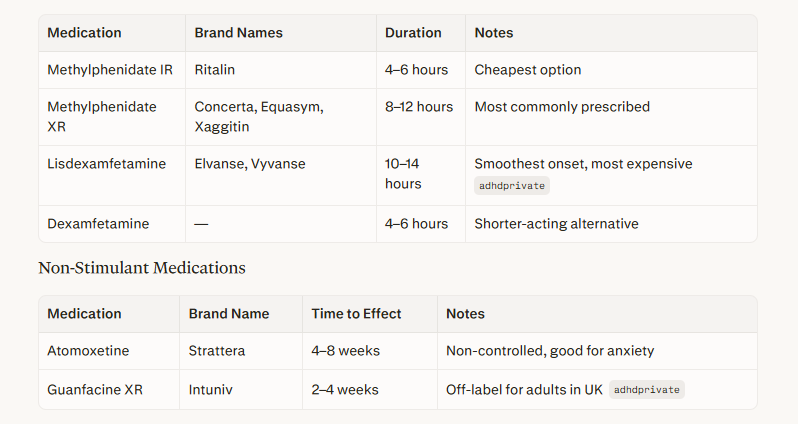
Private clinics can prescribe all standard ADHD stimulants:
Key Advantage of Private Prescribing
Private clinics can sometimes access medications more quickly or offer brand-name options that some NHS areas restrict due to cost-cutting measures. The medications themselves are identical to NHS prescriptions.
Choosing a Private ADHD Clinic: What to Look For
Essential Credentials
✅ CQC Registration: Care Quality Commission registration ensures minimum standards
✅ GMC-Registered Psychiatrists: General Medical Council registration for prescribers
✅ NICE-Compliant Assessments: Following national clinical guidelines
✅ Shared Care Offerings: 172 of 197 clinics offer SCAs
✅ Transparent Pricing: Clear cost breakdown before booking
Red Flags to Avoid
❌ No CQC registration or unclear credentials
❌ Promises of "guaranteed diagnosis"
❌ No follow-up or monitoring requirements
❌ Pressuring you into expensive packages
❌ Unwillingness to provide detailed reports for GPs
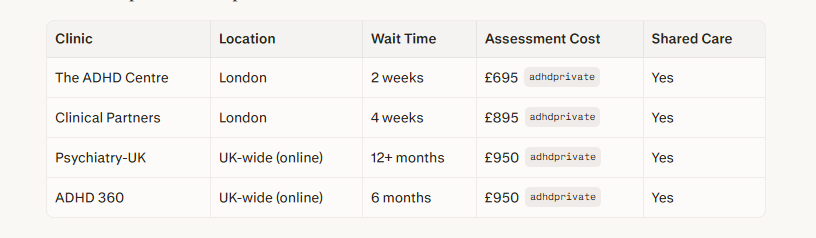
Clinic Comparison Examples
NHS Right to Choose: A Hybrid Option
What Is NHS Right to Choose?
Available in England only, NHS Right to Choose allows you to:
Request referral to an ADHD provider of your choice
Choose from NHS-accredited private providers
Receive NHS-funded assessment and treatment
Potentially reduce waiting times significantly
Benefits of Right to Choose
NHS-funded (no assessment or medication costs)
Faster than standard NHS (often weeks to months vs years)
GP shared care guaranteed (provider follows NHS protocols)
Same quality standards as direct NHS care
Limitations
Only available in England (not Scotland, Wales, or Northern Ireland)
Still has waiting times (some providers 6–12+ months)
Limited provider choice (must be NHS-accredited)
Regional restrictions may apply
Important Considerations Before Going Private
1. Long-Term Financial Commitment
Private ADHD treatment is not a one-time cost. If shared care isn't secured, you're committing to:
£60–£160 monthly for medication indefinitely
£100–£300 annually for monitoring
Potential price increases as medication costs rise
2. Your GP's Stance on Shared Care
Before booking private assessment:
Speak with your GP about their shared care policy
Ask if they accept private ADHD diagnoses
Get their agreement in writing if possible
Consider that policies can change even after initial agreement
3. Diagnosis May Not Be Accepted
An NHS clinician may disagree with your private diagnosis and require reassessment. A private diagnosis:
Cannot advance your position on NHS waiting lists
Cannot bypass NHS assessment if you later seek NHS treatment
May need to be confirmed by NHS services
4. Insurance Coverage
Some private medical insurance policies may cover psychiatric assessments or mental health diagnostics, but ** coverage varies significantly by provider and policy**. Always check your policy details before booking.
FAQs About Private ADHD Prescribing in the UK
Q1: Is private ADHD prescribing legal in the UK?
A: Yes, private ADHD prescribing is completely legal and regulated. Private clinics must be CQC-registered, and psychiatrists must be GMC-registered. Stimulant medications are controlled drugs but can be legally prescribed privately with proper documentation.
Q2: Will my GP automatically prescribe ADHD medication after private diagnosis?
A: No. Your GP has the right to refuse NHS prescriptions for privately diagnosed ADHD. Many GPs will not enter shared care agreements, especially if you're a fully private patient (not Right to Choose). You must confirm your GP's policy before proceeding.
Q3: How much does private ADHD medication cost per month?
A: Average monthly costs range from £60–£160, including pharmacy delivery fees. Stimulants like Elvanse tend to be more expensive (£80–£130) than methylphenidate options (£50–£100).
Q4: Can I switch from private to NHS treatment later?
A: Yes, but your private diagnosis will need to be reassessed and confirmed as NICE-compliant by NHS services. You cannot bypass the NHS waiting list with a private diagnosis, and NHS clinicians determine the clinically appropriate treatment.
Q5: What's the difference between private and NHS ADHD medication?
A: The medications are identical. The difference is that private prescriptions cost more if not under shared care. Private clinics may access medications faster or offer brand-name options some NHS areas restrict.
Q6: How long does a private ADHD assessment take?
A: Initial assessment is 90–120 minutes. Full diagnostic process (including follow-up confirmation) typically takes 2–4 weeks from booking to final diagnosis, compared to 18 months–3+ years on NHS lists.
Q7: Can I get private ADHD medication without a full assessment?
A: No. A formal diagnosis from a qualified private psychiatrist following NICE guidelines is required before any ADHD medication can be prescribed. Reputable clinics won't prescribe without proper assessment.
Q8: What happens if I can't afford ongoing private prescription costs?
A: Options include:
Requesting shared care agreement transfer to NHS GP
Switching to cheaper generic medications (e.g., methylphenidate vs. Elvanse)
Using prescription prepayment certificates if on NHS shared care
Discussing financial concerns with your clinic for payment plans
Q9: Do private clinics offer video consultations?
A: Yes, most private ADHD clinics offer video consultations UK-wide, making treatment accessible regardless of location. Some clinics like Psychiatry-UK and ADHD 360 operate entirely online.
Q10: Are private ADHD diagnoses recognized outside the UK?
A: It depends on the country. A UK private diagnosis from a GMC-registered psychiatrist following NICE guidelines is generally recognized in Commonwealth countries and EU nations, but you should verify recognition in your specific destination country before relocating.
The Bottom Line: Is Private ADHD Prescribing Right for You?
Private ADHD prescribing offers speed, choice, and control — but at a significant financial cost. It's most suitable for:
✅ Adults who can afford £1,500–£4,000+ in first-year costs
✅ Those unable to wait 18+ months for NHS assessment
✅ People in regions with particularly long NHS waiting lists
✅ Individuals whose employment or mental health urgently requires treatment
✅ Those whose GPs have confirmed they'll accept shared care
Private prescribing may not be suitable for:
❌ People on tight budgets without long-term financial cushion
❌ Those unwilling to commit to ongoing monthly costs if shared care fails
❌ Individuals who haven't confirmed GP shared care acceptance
❌ People who prefer to stay within fully NHS-funded care
Take Control of Your ADHD Treatment Today
Waiting years for ADHD treatment shouldn't be your only option. Whether you choose private prescribing, NHS Right to Choose, or a combination approach, access to timely diagnosis and treatment can transform your quality of life.
Thousands of UK adults are already benefiting from private ADHD care — gaining focus, improving relationships, and reclaiming their confidence. The key is entering the process informed, with realistic expectations about costs and GP acceptance.
Ready to explore your ADHD treatment options? Access ADHD-friendly tools, evidence-based resources, and pre-registration for upcoming nurse-led assessments to support your journey:
Visit Focus Gently for clinically-informed ADHD resources and digital planners: https://www.focusgently.com/