
You should consider an ADHD assessment when persistent difficulties with attention, organisation, restlessness or impulsivity repeatedly affect daily life—not simply because you recognise an occasional symptom. For adults, NICE recommends specialist assessment when typical symptoms began in childhood, have persisted and are associated with moderate or severe impairment that is not better explained by another psychiatric condition.nice.org
That does not mean you must already know that you have ADHD. An assessment is designed to explore what is causing your difficulties, whether ADHD is the right explanation and what support may be appropriate.
This guide explains common signs of ADHD, the patterns that make assessment worthwhile, and how to prepare for a meaningful conversation with a clinician.
What Are the Main Signs of ADHD?
ADHD is a neurodevelopmental condition characterised by inattention and/or hyperactivity and impulsivity. These difficulties must extend beyond the normal variation expected for someone’s age and developmental level. Their appearance and severity can change over a person’s lifetime.
Not everyone experiences the same combination of symptoms. Someone may mainly struggle with concentration and organisation, while another person experiences more obvious restlessness or difficulty holding back immediate responses.
The following examples illustrate recognised symptom patterns; they are not a self-diagnostic test.
Inattention: difficulty directing and sustaining focus
Inattention can involve:
Becoming easily distracted during tasks or conversations.
Missing details or making repeated mistakes.
Struggling to follow a series of instructions.
Starting activities but leaving them unfinished.
Frequently losing necessary belongings.
Forgetting responsibilities.
Difficulty organising work or household tasks.
Avoiding activities requiring sustained mental effort.
For example, you might begin paying a bill, become distracted by another notification and later discover that the payment was never completed.
Hyperactivity: movement or internal restlessness
Hyperactivity may involve fidgeting, difficulty remaining still or feeling unusually restless. In adults, it can be experienced as an internal need to keep moving rather than visibly running around.
An energetic personality alone does not establish ADHD. The question is whether activity levels are difficult to regulate and contribute to significant problems.
Impulsivity: difficulty pausing before responding
Impulsivity can appear as interrupting, struggling to wait or acting before considering consequences. These behaviours become clinically relevant when they form a repeated pattern that interferes with functioning.
A clinician will explore how often they occur, where they happen and what impact they have.
When Do These Signs Suggest an Assessment Is Worthwhile?
The most useful distinction is between recognising isolated traits and identifying a persistent, impairing pattern.
1. The difficulties keep happening
An occasional forgotten appointment or distracted afternoon is not enough. ADHD assessment looks for longstanding difficulties rather than a temporary response to a demanding week.
NHS Scotland guidance describes ADHD as a childhood-onset condition, although its signs may only be recognised later.
2. More than one area of life is affected
NICE requires symptoms to occur often in at least two important settings, such as home, work, education or social situations.
Examples might include:
Missing deadlines at work and struggling with household administration.
Forgetting university tasks and repeatedly losing essential belongings.
Interrupting colleagues and experiencing similar difficulties in family conversations.
Symptoms do not need to look identical everywhere. Different environments place different demands on attention and self-regulation.
3. There are meaningful consequences
Assessment is particularly relevant when difficulties affect relationships, education, employment, psychological wellbeing or everyday responsibilities.
NICE describes at least moderate impairment as part of the diagnostic threshold. This means clinicians consider the consequences of symptoms—not just whether a person recognises them.
4. There are clues from earlier life
Adults do not need to have been diagnosed as children. However, assessment looks for early-appearing, longstanding problems with attention or self-control.
Relevant memories might include repeatedly losing school equipment, struggling to complete work, needing extensive reminders or receiving similar feedback across different school years.
If childhood memories are uncertain, discuss that uncertainty. NICE specifically advises against excluding ADHD solely because the time of onset is unclear.
Everyday Examples That May Justify a Discussion
A symptom becomes more informative when you can explain its impact.
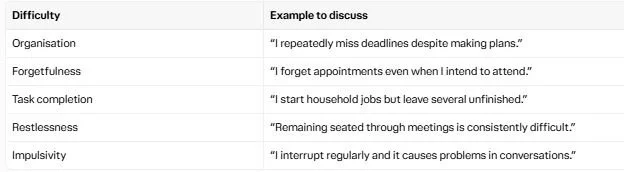
These examples draw on recognised difficulties with attention, organisation, activity and self-control. None confirms ADHD independently.
When preparing for assessment, describe actual incidents rather than trying to use particular diagnostic language. Clear examples are more helpful than presenting a rehearsed list.
Can You Have ADHD if You Seem Successful?
Academic achievement or professional success should not be the only focus of an assessment. NICE requires consideration of functioning across social, family, educational and occupational settings.
A person may meet work targets but repeatedly struggle with home responsibilities. Another may achieve good results while relying heavily on structure or support.
Equally, success does not prove that hidden ADHD must be present. The clinician still needs to establish symptoms, developmental history and impairment.
Discuss what daily functioning involves, where difficulties occur and which supports are already in place. Avoid assuming that either achievement or struggle settles the diagnosis.
Why Are Some People Recognised Later?
ADHD is thought to be under-recognised in girls and women. NICE notes that they may be less likely to receive an assessment referral, more likely to remain undiagnosed and more likely to receive an incorrect diagnosis of another condition.
This does not mean all women have a particular presentation or that previous diagnoses were necessarily wrong. It means assessment should not depend on a narrow stereotype of disruptive childhood behaviour.
Adults may also seek help only after recognising a longstanding pattern. Clinicians should consider age-related changes in behaviour rather than expecting adult ADHD to look exactly like childhood ADHD.
What Else Could Explain the Difficulties?
An ADHD assessment should test the explanation, not simply confirm an assumption.
NHS Scotland guidance states that symptoms should not be better explained by another mental or physical disorder or substance use. NICE also requires assessment of coexisting conditions, physical health and social circumstances.
Tell the clinician about:
Anxiety, depression or other mental-health difficulties.
Sleep and current stress.
Alcohol or recreational substance use.
Prescribed medicines.
Physical-health concerns.
Other neurodevelopmental conditions.
Recent changes in symptoms.
A recent decline in concentration deserves medical attention, but it should not automatically be labelled ADHD. Another explanation may be more relevant, or several difficulties may be occurring together.
What Can an Online ADHD Screening Test Tell You?
A recognised screening questionnaire can help organise symptoms and indicate whether further investigation may be useful.
For example, the Adult ADHD Self-Report Scale asks about symptom frequency and encourages discussion of impairment and childhood history. Its purpose is to support screening and a more detailed clinical interview.
It cannot provide a definitive diagnosis. NICE states that ADHD should not be diagnosed solely from rating scales or observational information.
Avoid treating a high score as proof or a low score as the final answer. Bring the results to a clinician alongside real-life examples.
How to Prepare for an ADHD Assessment
Preparation should help you describe your experience accurately, not “pass” an assessment.
Write a short timeline
Include when you first noticed difficulties, how they appeared during education and how they affect life now.
Record specific examples
Choose a few examples from different settings. Explain their frequency and consequences.
Gather information where available
School reports, previous clinical reports or observations from someone who knows you well may help. Diagnosis commonly draws on clinical history, corroborative information and structured assessment.
List existing conditions and treatments
Include medicines, previous assessments and support you have tried.
Note your goals
You might want an explanation for repeated difficulties, practical recommendations or a discussion of treatment options. Be clear about what you hope the assessment will address.
What Happens During an Assessment?
NICE recommends diagnosis by a specialist psychiatrist, paediatrician or another appropriately qualified professional with ADHD expertise. The process should include:
A full clinical and psychosocial assessment.
Developmental and psychiatric history.
Discussion of symptoms across settings.
Observer information.
Assessment of mental state.
Consideration of other conditions and individual needs.
A referral does not guarantee an ADHD diagnosis. The outcome may identify ADHD, another explanation, coexisting conditions or a need for further investigation. The purpose is accurate understanding and appropriate recommendations.
How Do You Access an Assessment in the UK?
A GP is a useful starting point for discussing symptoms and local referral options. NHS adult services commonly accept referrals through primary care, although pathways vary.
Private assessment is another option. Before booking, check the clinician’s qualifications, assessment process, written-report arrangements and what happens afterwards.
If medication might be considered, ask about follow-up, monitoring and ongoing costs. Do not assume that an NHS GP will automatically take over private prescribing: shared care requires agreement, and some practices decline.
For children, speak with the GP and relevant school staff. NICE recommends direct specialist referral when suspected ADHD is associated with severe impairment; support for parents need not always wait for a formal diagnosis.
FAQs
How do I know whether my symptoms are serious enough?
Consider their persistence, frequency and impact across settings. You do not need certainty before discussing concerns with a clinician. Referral and diagnosis involve evaluating impairment and alternative explanations.
Can adults be assessed without a childhood diagnosis?
Yes. NICE explicitly provides a referral pathway for adults without a childhood diagnosis when there is evidence of longstanding symptoms and significant impairment.
What if I cannot find school reports?
Tell the assessor. Reports can help, but assessment also involves clinical history and other information. Ask what alternative evidence may be useful rather than assuming you cannot proceed.
Can anxiety and ADHD occur together?
Yes. Another psychiatric condition does not automatically rule out ADHD. The clinician must assess whether it better explains the symptoms or coexists with ADHD.
Do I need obvious hyperactivity?
No. ADHD may involve inattention and/or hyperactive-impulsive symptoms. Significant inattentive difficulties can justify assessment without prominent physical hyperactivity.
Will a diagnosis mean I must take medication?
No. Treatment decisions should reflect individual needs, preferences and informed discussion of medication and non-medication options.
What if the assessment does not identify ADHD?
Your difficulties still matter. NICE notes that people whose symptoms fall short of an ADHD diagnosis may benefit from information and support. Ask what other explanations or next steps are recommended.
Book an ADHD Assessment
Stop Second-Guessing. Take a Clear Next Step.
If attention, organisation, restlessness or impulsivity repeatedly makes daily life harder, a professional assessment can help you understand the pattern rather than relying on online comparisons.
Focus Gently offers comprehensive online adult ADHD assessments with a written report. Its clinician-led service supports assessment, treatment planning and medication care where clinically appropriate.