Weiss Functional Impairment Scale for ADHD: The Complete Guide to Measuring Real-World Impact

When you're diagnosed with ADHD, doctors don't just look at how many symptoms you have—they also need to understand how ADHD affects your daily life. This is where the Weiss Functional Impairment Scale (WFIRS) comes in.
The Weiss Functional Impairment Scale is a scientifically validated, widely-used assessment tool that measures how ADHD impacts a person's functioning across multiple areas of life—not just whether they have symptoms, but how those symptoms affect their real-world ability to function at home, work, school, and in relationships.
While symptom rating scales tell doctors what ADHD symptoms someone has, functional impairment scales like the WFIRS tell them how much those symptoms actually matter in everyday life. This distinction is crucial for making treatment decisions, tracking progress, and ensuring ADHD treatment improves more than just symptom counts—it improves your quality of life.
This comprehensive guide explains everything you need to know about the Weiss Functional Impairment Scale for ADHD, including what it measures, how scoring works, why it matters, and answers to frequently asked questions.
What Is the Weiss Functional Impairment Scale?
The Weiss Functional Impairment Scale (WFIRS) is a comprehensive assessment tool designed to measure functional impairment in individuals with ADHD. Developed by Dr. Russell Weiss, a leading ADHD researcher and clinician, the WFIRS evaluates how ADHD affects functioning across multiple life domains.
Key Features of the WFIRS
The WFIRS is unique because it:
Measures real-world impact, not just symptoms
Covers multiple life domains (family, school/work, social, self-care, etc.)
Is scientifically validated and widely used in clinical trials and practice
Has different versions for different raters (self, parent, observer)
Can be used for children, adolescents, and adults
Is sensitive to treatment changes, making it useful for tracking progress
The scale is based on the understanding that ADHD is a disorder of functioning, not just a collection of symptoms. Two people can have similar symptom counts but vastly different levels of functional impairment depending on their environment, support systems, and coping strategies.
Why Functional Impairment Matters More Than Symptoms Alone
The Critical Distinction
Many people misunderstand ADHD assessment. The key insight is:
Symptoms ≠ Impairment
Symptoms are the presence of ADHD characteristics (inattention, hyperactivity, impulsivity)
Impairment is how much those symptoms interfere with your ability to function in daily life
Someone can have ADHD symptoms but minimal impairment if they have strong support systems, appropriate accommodations, or work in environments that suit their strengths. Conversely, someone with moderate symptoms can have severe impairment if their environment is highly demanding or unsupportive.
Why This Matters for Treatment
NICE guidelines and other clinical standards emphasize that treatment decisions should be based on functional impairment, not just symptom count. This is because:
Treatment goal is improved functioning, not just reduced symptoms
Medication should improve daily life, not just ADHD symptom scores
Functional impairment predicts quality of life better than symptoms alone
Assessing impairment helps identify which life areas need most support
The WFIRS is one of the most comprehensive tools for measuring this functional impairment across all major life domains.
The Different Versions of the WFIRS
The Weiss Functional Impairment Scale comes in several versions to accommodate different ages and raters:
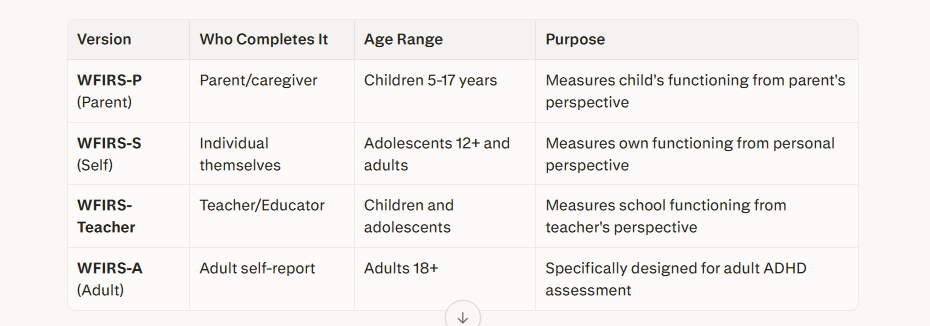
WFIRS-P (Parent Version)
The WFIRS-P is completed by a parent or caregiver and is particularly important for assessing children with ADHD. Parents provide crucial information about how ADHD affects the child across different settings, especially at home.
WFIRS-S (Self-Report Version)
The WFIRS-S allows individuals to report on their own functioning. This is valuable because:
Self-perception matters for treatment adherence and motivation
Individuals may notice impairment others don't see
Helps identify subjective burden of ADHD symptoms
Essential for adults who are the best judges of their own functioning
WFIRS-A (Adult Version)
The WFIRS-A is specifically calibrated for adult ADHD and addresses adult-specific life domains including work performance, relationships, and independent living skills.
What Domains Does the WFIRS Measure?
The WFIRS measures functional impairment across six major life domains, each containing multiple items:
1. Family Life
Covers impairment in family relationships and dynamics, including:
Family conflicts and arguments
Communication within the family
Ability to follow family rules
Impact on family activities
Parent-child relationship strain
2. School or Work
Measures impairment in academic or occupational functioning, including:
For children: School performance, completing homework, following classroom rules
For adults: Work productivity, meeting deadlines, job performance
Attendance and punctuality
Ability to complete tasks
Organization and time management
3. Social Life
Assesses impairment in social relationships and interactions, including:
Making and keeping friends
Social skills and appropriateness
Ability to participate in group activities
Social isolation or rejection
Relationship difficulties
4. Self-Care
Evaluates impairment in personal care and daily living skills, including:
Personal hygiene and grooming
Managing daily routines
Organization of personal space
Time management for self-care tasks
Health maintenance
5. Risky Behavior
Assesses engagement in potentially harmful activities, including:
Substance use or experimentation
Dangerous activities or recklessness
Impulsive decisions with potential harm
Legal problems
Risk-taking tendencies
6. Life Skills / Organization
Measures impairment in executive functioning and organizational skills, including:
Planning and organizing tasks
Managing finances
Keeping appointments
Following through on commitments
Managing belongings and possessions
How the WFIRS Is Scored
Scoring System
The WFIRS uses a 4-point Likert scale for each item:

Calculating Domain Scores
Each domain has a total score calculated by summing the item scores within that domain. Higher scores indicate greater functional impairment.
Overall Score
An overall functional impairment score can be calculated by summing all domain scores. This provides a single number representing total functional impairment across all life areas.
Interpretation of Scores

Important: There are no universally standardized "cutoff" scores. Interpretation should consider:
Individual baseline functioning
Comparison to normative data (when available)
Clinical judgment
Changes over time with treatment
Tracking Changes Over Time
One of the WFIRS's greatest strengths is its sensitivity to change. By administering the WFIRS before and after treatment begins, clinicians can objectively measure whether treatment is improving functional impairment—not just reducing symptoms.
When Is the WFIRS Used in ADHD Care?
The WFIRS is used at multiple points in ADHD assessment and treatment:
1. Initial Assessment
During the initial ADHD evaluation, the WFIRS helps:
Establish baseline functioning before treatment
Identify which life domains are most affected
Inform treatment priorities
Determine if impairment is severe enough to warrant medication
2. Treatment Planning
The WFIRS results help clinicians:
Prioritize which life domains need most attention
Decide whether to focus on medication, therapy, or both
Identify need for accommodations or support services
Set realistic treatment goals
3. Monitoring Treatment Response
By repeating the WFIRS during treatment, clinicians can:
Objectively measure improvement in functional impairment
Determine if medication is working as intended
Identify which areas have improved and which haven't
Make informed decisions about dose adjustments
4. Annual Reviews
The WFIRS is particularly valuable for annual ADHD reviews under NICE NG87 guidelines, as it provides comprehensive assessment of functional impairment across all life domains.
5. Research and Clinical Trials
The WFIRS is widely used in ADHD research because it provides a standardized, validated measure of functional outcomes that can be compared across studies.
What the Research Says About WFIRS
Validation Studies
The WFIRS has been extensively validated in multiple studies:
Strong psychometric properties including reliability and validity
Sensitive to treatment effects in medication trials
Correlates well with other measures of impairment
Applicable across ages from children to adults
Cross-cultural validity in multiple countries
Clinical Utility
Studies have shown that:
WFIRS scores improve with effective ADHD treatment
Functional impairment measures predict quality of life better than symptoms alone
Multiple domains often impaired even when symptoms are controlled
Parent and self-report often differ, highlighting need for both perspectives
WFIRS helps identify residual impairment even after symptom improvement
Limitations
While the WFIRS is highly regarded, it has some limitations:
Time-consuming to complete (15-20 minutes for full scale)
Requires literacy to complete self-report versions
Cultural differences may affect interpretation
No universal cutoff scores for diagnosis
Subject to rater bias (especially parent and self-report)
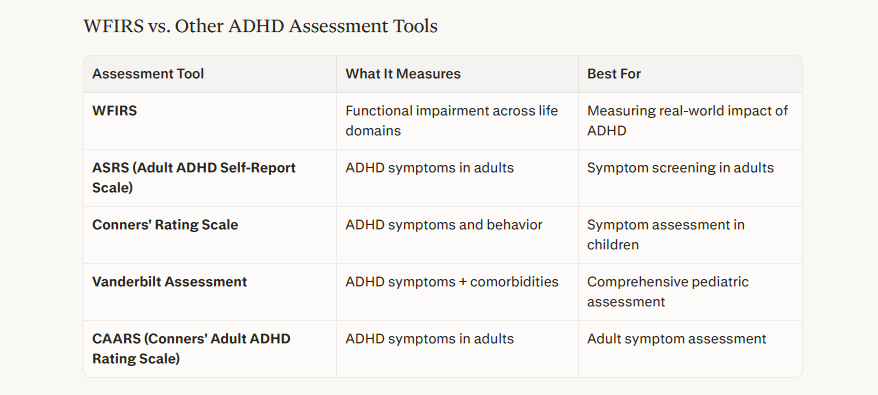
Key distinction: The WFIRS is unique because it focuses on functional impairment, not just symptoms. Most other tools measure symptom presence, while WFIRS measures how much those symptoms actually matter in daily life.
FAQs About the Weiss Functional Impairment Scale
Q1: What is the Weiss Functional Impairment Scale?
A: The WFIRS is a scientifically validated assessment tool that measures how ADHD affects a person's functioning across multiple life domains (family, school/work, social, self-care, risky behavior, and organization). It measures real-world impact, not just symptoms.
Q2: What's the difference between WFIRS-P and WFIRS-S?
A: WFIRS-P (Parent version) is completed by a parent/caregiver about a child's functioning. WFIRS-S (Self-report) is completed by the individual themselves about their own functioning. Both provide valuable, complementary perspectives.
Q3: How is the WFIRS scored?
A: Each item is scored 0-3 (Never to Very Often). Domain scores are calculated by summing items within each domain. Higher scores indicate greater functional impairment. An overall score can be calculated by summing all domains.
Q4: What do WFIRS scores mean?
A: Low scores indicate minimal impairment; moderate scores indicate some impairment; high scores indicate severe impairment. There are no universal cutoff scores—interpretation depends on clinical context and changes over time.
Q5: When is the WFIRS used?
A: The WFIRS is used during initial assessment (baseline), treatment planning, monitoring treatment response, and annual reviews. It helps identify which life areas are most affected and whether treatment is improving functioning.
Q6: Can the WFIRS be used for adults with ADHD?
A: Yes. The WFIRS has versions for adults (WFIRS-A) and adolescents (WFIRS-S). It measures adult-specific life domains including work performance, relationships, and independent living skills.
Q7: Is the WFIRS part of an ADHD diagnosis?
A: The WFIRS is not a diagnostic tool itself, but it's essential for determining if ADHD causes clinically significant impairment, which is required for diagnosis. Functional impairment is a core diagnostic criterion for ADHD.
Q8: How long does it take to complete the WFIRS?
A: The full WFIRS takes approximately 15-20 minutes to complete. Shorter versions exist but may not capture all life domains.
Q9: Should both parent and child complete the WFIRS?
A: Yes, when possible. Parent and self-report often differ, providing complementary perspectives. Discrepancies between reports can reveal important information about awareness and insight.
Q10: Can the WFIRS show if medication is working?
A: Yes. The WFIRS is sensitive to treatment changes. By comparing scores before and after medication, clinicians can objectively measure whether treatment is improving functional impairment, not just reducing symptoms.
Q11: What makes the WFIRS better than other assessment tools?
A: Unlike most ADHD tools that measure symptoms only, the WFIRS measures functional impairment—how symptoms actually affect daily life. This is more meaningful for treatment decisions and quality of life.
Q12: Are there cutoff scores for ADHD diagnosis?
A: No universal cutoff scores exist. Interpretation depends on clinical judgment, comparison to normative data, individual baseline functioning, and changes over time. The WFIRS is best used alongside other assessment tools.
Q13: Can the WFIRS be used for children?
A: Yes. The WFIRS-P (Parent version) is specifically designed for children ages 5-17. It measures impairment in school, family life, social relationships, and other child-specific domains.
Q14: Is the WFIRS used in NHS ADHD assessments?
A: Increasingly yes. Many NHS ADHD clinics use the WFIRS as part of comprehensive assessment, particularly for annual reviews under NICE NG87 guidelines. However, usage varies by clinic.
Q15: Where can I get the WFIRS?
A: The WFIRS is a proprietary assessment tool typically available through healthcare providers, researchers, or licensed assessment platforms. It's not publicly available for self-administration without professional oversight.
The Bottom Line: Why Functional Impairment Matters
The Weiss Functional Impairment Scale represents a crucial shift in how we understand and treat ADHD. Rather than simply counting symptoms, the WFIRS asks the more important question: How much does ADHD actually interfere with your life?
Key Takeaways
WFIRS measures functional impairment, not just symptoms
Six major life domains are assessed: family, school/work, social, self-care, risky behavior, and organization
Multiple versions exist for different ages and raters (parent, self, teacher)
Scientifically validated and widely used in clinical practice and research
Sensitive to treatment changes, making it valuable for tracking progress
Essential for treatment decisions and determining if ADHD warrants medication
Used in annual reviews to assess ongoing treatment effectiveness
Functional impairment predicts quality of life better than symptoms alone
Why You Should Care About Your WFIRS Scores
If you're being assessed for ADHD or are currently in treatment, understanding your functional impairment is just as important as understanding your symptoms. The WFIRS helps answer critical questions:
Is my ADHD significantly impacting my life?
Which areas need the most support?
Is my treatment actually improving my daily functioning?
Where should I focus my treatment goals?
Ready to Experience Comprehensive ADHD Assessment?
Understanding how ADHD affects your daily life is the first step toward meaningful treatment and improvement. Whether you're seeking your first assessment, wondering if your current treatment is working, or preparing for an annual review, the right healthcare professionals use tools like the WFIRS to ensure treatment addresses more than just symptoms—it addresses your quality of life.
Get comprehensive ADHD assessment and treatment that measures what truly matters: real-world functional improvement.
Visit FocusGently.com to learn about ADHD assessment using evidence-based tools like the Weiss Functional Impairment Scale and connect with experienced healthcare professionals