Elvanse vs Dexamfetamine: Differences and Dose Conversions

Elvanse (lisdexamfetamine) and dexamfetamine are closely related ADHD medicines: the body converts Elvanse into dexamfetamine, which is the active stimulant. The practical difference is how the medicine is delivered and how long its effects may last. Elvanse is usually taken once in the morning for extended coverage; dexamfetamine is usually shorter-acting and may require more than one dose during the day.
Although the medicines are related, they are not direct, self-managed substitutes. Dose conversion and switching need a prescriber’s plan, clinical monitoring, and a prescription for the new medicine.
This guide is for general education, not a personal dosing or conversion plan.
What Are Elvanse and Dexamfetamine?
Elvanse: a long-acting prodrug
Elvanse is the UK brand name for lisdexamfetamine. It is a prodrug: after it is absorbed, the body converts it into dexamfetamine. This gradual conversion is why Elvanse is generally taken once daily in the morning. In clinical studies, its effects were observed to continue for up to 13 hours in children and 14 hours in adults, although an individual’s real-world duration may be shorter or longer.
Dexamfetamine: the active medicine directly
Dexamfetamine is prescribed directly in immediate-release formulations. Because it does not need to be converted from lisdexamfetamine, its effects typically begin sooner and wear off earlier. UK switching guidance describes immediate-release dexamfetamine as offering a shorter, more adjustable period of cover, often requiring twice- or three-times-daily dosing depending on the person and clinical plan.
Both medicines are stimulants used as part of an overall ADHD treatment plan. They can improve attention, reduce impulsivity, and help manage hyperactivity, but response and tolerability vary.
Key Differences at a Glance
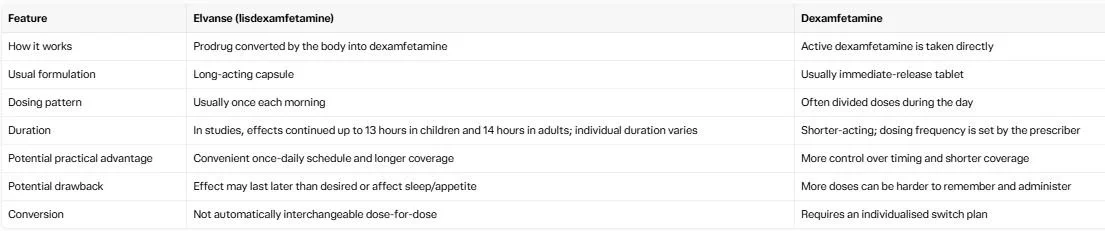
The duration figures are study findings, not a guarantee of how long either medicine will work for a particular person.
When Might a Clinician Use Elvanse?
Elvanse may be considered when a person needs sustained symptom control through much of the day and prefers a once-daily medicine. It may be useful when symptoms affect several parts of daily life, such as school or work, commuting, homework, parenting, or evening responsibilities.
UK guidance also sets out age-specific treatment pathways. For children and young people, NICE recommends considering lisdexamfetamine after an adequate six-week trial of methylphenidate has not provided enough benefit in reducing symptoms and impairment. For adults, NICE recommends either methylphenidate or lisdexamfetamine as a first-line pharmacological treatment.
Elvanse may not suit everyone. A long duration can be inconvenient if someone experiences late-day appetite suppression, insomnia, anxiety, or a feeling that the medication remains active beyond the hours they need it.
When Might Dexamfetamine Be Used?
NICE says to consider dexamfetamine for adults whose ADHD symptoms respond to lisdexamfetamine but who cannot tolerate its longer effect profile.
A specialist might consider it when:
Elvanse helps symptoms but appears to last too late into the evening.
A shorter period of medication cover is preferred.
More control over when the medicine is active would suit the person’s routine.
A person needs a different dosing pattern after an assessment of benefit and side effects.
Dexamfetamine may be less convenient for someone who needs all-day coverage, because immediate-release doses may need to be repeated. If doses are needed at school or work, practical arrangements and safe storage may also need consideration.
Use in adults may be outside the product licence in some circumstances; the prescriber should explain the rationale and discuss relevant alternatives.
How Do the Doses Convert?
There is no safe universal conversion that patients can use to switch between Elvanse and dexamfetamine on their own.
UK guidance documents may provide approximate equivalence information to support prescribers, but they also advise that switching is a clinical decision made case by case. One local protocol states that the medicines are not directly interchangeable.
Why isn’t conversion a simple arithmetic exercise?
Elvanse contains lisdexamfetamine, which is converted into active dexamfetamine.
The medicines are absorbed and released differently.
One dose of Elvanse is generally intended to provide longer coverage; immediate-release dexamfetamine is commonly divided across the day.
Individual response, side effects, duration, and dosing needs differ.
Product strengths and local guidance may vary.
Some clinical documents give a rough molecular equivalence as a reference for clinicians. That is not a personal prescription, does not account for release profile, and must not be used to calculate a switch without a prescriber.
A clinician deciding whether and how to switch will generally consider the current dose, the useful duration of effect, the reason for changing, the patient’s age and health, previous response, and monitoring results. They may choose a cautious starting dose and adjust according to response and tolerability. Switching guidance recommends monitoring blood pressure and pulse during dose changes.
What Might a Prescriber Review Before Switching?
Before changing from Elvanse to dexamfetamine, or the other way round, a clinician may review:
Which ADHD symptoms improve and which remain.
How long the current medicine appears to work.
Whether the effect fades smoothly or is followed by rebound symptoms.
Appetite, weight, sleep, mood, and anxiety.
Blood pressure and pulse.
Work, school, caregiving, or driving requirements.
Other medicines and relevant medical history.
Adherence, missed doses, and practical barriers.
Whether the aim is shorter coverage, longer coverage, improved tolerability, or a response to supply problems.
It can help to keep a short record of dose time, perceived onset and end of effect, appetite, sleep, and symptom control. Bring it to the appointment; it can support a clearer, more individualised discussion.
Side Effects and Monitoring
Because both medicines are dexamfetamine-based stimulants, they can share potential adverse effects. These may include reduced appetite, weight loss, difficulty sleeping, headache, dry mouth, anxiety, irritability, and increases in heart rate or blood pressure.
A different release profile does not guarantee fewer side effects. For example, a shorter-acting medicine may reduce late-day effects for one person but create a more noticeable rise and fall in symptoms for another.
Prescribers should monitor clinical response and adverse effects, and assess relevant physical health during treatment. NICE recommends reviewing ADHD medication at least annually, as well as monitoring symptoms, impairment, and side effects as treatment is adjusted.
Seek prompt medical advice for concerning symptoms such as chest pain, fainting, severe palpitations, major mood changes, or unusual thoughts or behaviour. For an emergency, use emergency services.
What If There Is a Supply Problem?
If your pharmacy cannot supply Elvanse or dexamfetamine, contact your prescriber or pharmacist before making any change. The pharmacy cannot usually substitute one medicine for another simply because the usual medicine is unavailable: the formulation and prescribed dose need to be clinically reviewed, and a new prescription may be required.
Do not:
Take another person’s medicine.
Use an old dose-conversion table to change treatment yourself.
Combine capsules or tablets to recreate a dose unless instructed.
Buy ADHD medication from an unregulated seller.
Double a later dose to make up for one missed earlier.
Ask the prescriber what to do if your supply is running low and how to manage any interruption safely.
FAQs
Are Elvanse and dexamfetamine the same medicine?
They are closely related, but they are not the same formulation. Elvanse contains lisdexamfetamine, which the body converts into dexamfetamine. Dexamfetamine tablets provide the active medicine directly.
Which lasts longer?
Elvanse is designed to provide longer coverage. Clinical studies reported effects continuing up to 13 hours in children and 14 hours in adults, while dexamfetamine immediate-release is shorter-acting. Individual duration varies.
Is dexamfetamine stronger than Elvanse?
“Stronger” is not a useful direct comparison because the medicines have different formulations, release patterns, and dosing schedules. A prescriber should compare how well each one controls symptoms and how it affects daily functioning and side effects.
Can I change from Elvanse to dexamfetamine at the same milligram dose?
No. Do not switch at the same milligram dose or calculate a conversion yourself. Local guidance warns that the medicines are not directly interchangeable and that switching should be individually planned.
Why might someone switch from Elvanse to dexamfetamine?
NICE recommends considering dexamfetamine for adults whose symptoms respond to lisdexamfetamine but who cannot tolerate its longer duration of effect. A clinician may also consider dosing flexibility and the person’s daily routine.
Can a child use dexamfetamine?
Dexamfetamine may be prescribed for some children and young people under specialist care, but its use and place in treatment depend on the person’s age, clinical circumstances, product licence, and local guidance. Discuss the specific situation with the child’s ADHD specialist.
Will dexamfetamine cause less insomnia?
Not necessarily. A shorter duration may be helpful for some people, but sleep effects depend on dose, dose timing, individual sensitivity, and the full treatment plan. A prescriber should assess insomnia rather than assuming a switch will resolve it.
Can I take both Elvanse and dexamfetamine together?
Do not combine them unless a specialist has explicitly prescribed that plan. Combining stimulant medicines is not a routine approach and requires specialist assessment.
What should I do if I miss a dose?
Follow the instructions on your prescription and patient leaflet. Do not double the next dose. If you are unsure—especially if it is late in the day—ask your pharmacist or prescriber.
Book an ADHD Assessment
Choosing between Elvanse and dexamfetamine should start with understanding how ADHD affects your life, what you want treatment to improve, and which options are appropriate for your circumstances.
Focus Gently offers ADHD assessments that explore symptoms, developmental history, day-to-day impact, and relevant coexisting conditions. A specialist assessment can help you understand your options and create a treatment plan that considers medication, practical strategies, and support at home, school, university, or work.
If attention, impulsivity, organisation, or emotional regulation is making daily life harder, you do not have to keep guessing about the cause or the next step.