Elvanse vs Methylphenidate: Choosing First-Line ADHD Treatment for Adults and Children in the UK

Elvanse (lisdexamfetamine) and methylphenidate are widely used stimulant medicines for ADHD in the UK, but they are not interchangeable. NICE recommends methylphenidate as the first-line medication for most children and young people aged 5 and over, while adults may be offered either methylphenidate or lisdexamfetamine as first-line pharmacological treatment.
The best choice depends on age, symptom pattern, duration of cover required, previous medication response, side effects, physical and mental health, school or work demands, and patient preference. Medication should be initiated and adjusted by a healthcare professional with appropriate ADHD expertise as part of a comprehensive treatment plan.
Important: This article is for general information and does not replace an assessment or individual prescribing advice.
What Are Elvanse and Methylphenidate?
Elvanse
Elvanse is the UK brand name for lisdexamfetamine. It is a prodrug that is converted in the body into dexamfetamine, an active stimulant that increases signalling in brain systems involved in attention, motivation, and impulse control.
In the UK, lisdexamfetamine is licensed for:
Adults with ADHD as part of a comprehensive treatment programme.
Children and young people aged 6 years and over when response to previous methylphenidate treatment is considered clinically inadequate.
Elvanse is usually taken once each morning. The licensed product information recommends a starting dose of 30 mg once daily, or 20 mg where a lower starting dose is appropriate, with increases of 10 mg or 20 mg at approximately weekly intervals. The maximum recommended dose is 70 mg daily.
Methylphenidate
Methylphenidate is available in immediate-release and modified-release formulations. Examples include immediate-release preparations and long-acting products such as Concerta XL, Medikinet XL, Equasym XL, and other branded or generic formulations.
Methylphenidate affects dopamine and noradrenaline signalling and is available in different release profiles. This allows clinicians to tailor treatment to the duration of cover required, although modified-release products are not automatically interchangeable.
NICE recommends methylphenidate as the first-line pharmacological treatment for children and young people aged 5 years and over. Adults may also be offered methylphenidate as a first-line option.
NICE First-Line Recommendations
The treatment pathway differs between children, young people, and adults.
Children and young people
For children aged 5 years and over and young people with ADHD, NICE recommends:
Offer methylphenidate as the first-line pharmacological treatment when medication is indicated.
Consider lisdexamfetamine after an adequate six-week trial of methylphenidate if there has not been enough benefit in reducing symptoms and impairment.
Consider dexamfetamine if lisdexamfetamine provides benefit but the longer duration of action is not tolerated or is unsuitable.
Consider atomoxetine or guanfacine when stimulants are not tolerated, ineffective, or unsuitable.
Medication should be combined with age-appropriate psychoeducation and support. For children, this may include parent training, classroom strategies, school adjustments, and support with routines and organisation.
Adults
For adults with ADHD, NICE recommends offering either:
Methylphenidate, or
Lisdexamfetamine.
The decision should reflect the person’s symptoms, functional demands, previous treatment, medical history, potential adverse effects, and preferences. If one option is ineffective or poorly tolerated after an adequate trial, the clinician may consider switching to the other.
This does not mean Elvanse is always “stronger” or methylphenidate is always “safer”. They are different treatments with different release profiles and individual responses.
Elvanse vs Methylphenidate: Key Differences
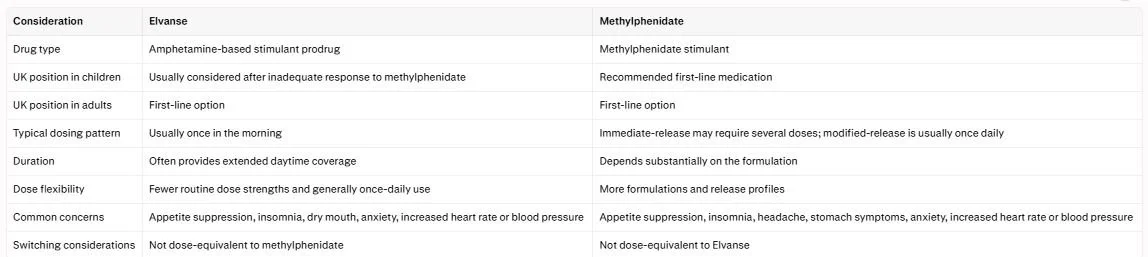
The table provides broad clinical distinctions. Individual products vary, and duration of effect can differ considerably between patients.
Duration and Daily Routine
One of the most important practical differences is how long the medication needs to work.
When Elvanse may suit the routine
A once-daily long-acting medicine may be helpful when:
Symptoms affect the entire school or working day.
The patient prefers not to take medication at school or work.
Midday doses are difficult to remember.
A consistent effect is preferred.
Afternoon homework, commuting, parenting, or household responsibilities require continued coverage.
Elvanse is not completely uniform for every person. Some experience a shorter or longer effect than expected, and some notice a late-day “wear-off” or rebound in symptoms.
When methylphenidate may offer flexibility
Methylphenidate may be useful when:
The patient needs a shorter period of treatment.
The person wants control over when medication is active.
A clinician wants to adjust the duration using immediate-release doses.
The patient requires a different release profile for school, work, or evening activities.
A modified-release formulation is useful but full-day coverage is not required.
The downside is that immediate-release methylphenidate may require multiple doses and can create practical challenges at school or work. Modified-release products offer longer coverage but may vary in duration and food requirements.
Effectiveness: Is One Better?
There is no universal winner. Both medicines can improve attention, impulse control, hyperactivity, and executive functioning when ADHD is the correct diagnosis and the dose is optimised.
Clinical studies support the use of both stimulant classes, but average study results do not predict exactly how an individual will respond. Some people experience clearer benefit with Elvanse, while others function better on methylphenidate.
A medication should be judged by:
Improvement in the symptoms that matter to the patient.
Better functioning at home, school, university, or work.
Improved task completion and organisation.
Better emotional regulation or reduced impulsivity.
Acceptable appetite, sleep, mood, and physical effects.
A duration that fits the patient’s day.
“Feeling different” is not necessarily evidence that medication is working. Likewise, an absence of euphoria does not mean the medicine is ineffective. The goal is improved functioning, not stimulation.
Side Effects and Tolerability
Elvanse and methylphenidate can cause similar stimulant-related adverse effects, although an individual may tolerate one better than the other.
Common concerns include:
Reduced appetite.
Weight loss or difficulty gaining weight.
Difficulty falling asleep.
Headache.
Stomach pain or nausea.
Dry mouth.
Irritability.
Anxiety or feeling tense.
Increased heart rate or blood pressure.
Tics or worsening of pre-existing tics in some people.
Methylphenidate information lists gastrointestinal symptoms, reduced appetite, cardiovascular effects, headache, and sleep-related problems among possible adverse effects.
The risk of side effects may depend on:
Dose.
Timing.
Release formulation.
Food and hydration.
Sleep quality.
Anxiety or mood disorders.
Caffeine, alcohol, or other substances.
Other prescribed medicines.
Cardiovascular health.
A side effect does not always mean that the medication must be stopped. The prescriber may adjust the dose, change the timing, alter the formulation, switch medicines, or treat a contributing problem. However, chest pain, fainting, severe palpitations, psychosis, mania, or severe mood changes need prompt medical assessment.
Children: Why Methylphenidate Usually Comes First
NICE places methylphenidate first for children and young people primarily because of its evidence base, licensing, clinical experience, and flexible formulations.
This does not mean methylphenidate is the best medicine for every child. A child may need a switch to Elvanse if:
A properly titrated methylphenidate trial has not provided enough benefit.
Side effects make methylphenidate unsuitable.
The release profile does not cover the school day.
Doses are repeatedly missed.
Symptoms remain significantly impairing at school and home.
For children, monitoring should include:
Appetite and food intake.
Weight and height plotted on growth charts.
Sleep.
Blood pressure and pulse.
Mood and behaviour.
Classroom functioning and peer relationships.
Teacher and parent observations.
Children should not be judged only by academic performance. Consider friendships, emotional wellbeing, family stress, independence, safety, and participation in activities.
Adults: Choosing Around Work, Driving, and Home Life
Adults may experience ADHD-related impairment across several settings, including:
Sustained attention at work.
Time management and deadlines.
Driving and road safety.
Household administration.
Parenting.
Emotional regulation.
Relationships.
Financial organisation.
Sleep and daily routines.
An adult who needs all-day coverage may prefer once-daily Elvanse. Another person may prefer methylphenidate because a shorter or more flexible duration fits shift work, variable schedules, or evening responsibilities.
Clinicians should ask not only, “Does it improve concentration?” but also:
Can you start tasks more reliably?
Are deadlines easier to manage?
Are you less impulsive in conversations or decisions?
Is driving safer and less distractible?
Are evenings affected by rebound, irritability, or insomnia?
Is appetite and weight stable?
Can you sleep at a suitable time?
Titration and Monitoring for Both Medicines
Both Elvanse and methylphenidate require careful titration. The aim is to find the lowest effective dose that improves symptoms and function while keeping adverse effects manageable.
Before starting, assess:
Cardiovascular history and family history.
Blood pressure and pulse.
Weight and height where relevant.
Mental-health history.
Sleep.
Tics and seizures.
Substance use and diversion risk.
Other medicines and supplements.
Pregnancy or breastfeeding where relevant.
During titration, review:
Symptoms and functional change.
Duration of benefit.
Appetite and weight.
Sleep.
Mood and anxiety.
Blood pressure and pulse.
Adherence.
New psychiatric or neurological symptoms.
NICE recommends recording symptoms, impairment, and adverse effects at baseline and at each dose change. Once treatment is established, medication should be reviewed at least annually by a healthcare professional with ADHD expertise.
Shortages and Formulation Availability
Supply issues can influence practical treatment decisions, but availability should not determine a medication switch without clinical review.
Elvanse and some methylphenidate products have experienced UK supply disruption at different times. The availability of one strength or brand may differ from another, and modified-release methylphenidate products are not automatically interchangeable.
If a pharmacy cannot supply your usual medication:
Contact the pharmacy before your supply runs out.
Ask whether another strength or formulation is available.
Contact your prescriber if a new prescription may be needed.
Do not substitute medicines or doses yourself.
Do not buy controlled medication from unregulated sources.
Frequently Asked Questions
Is Elvanse better than methylphenidate?
Not universally. Both can be effective, and the better choice depends on individual response, side effects, duration needed, age, medical history, and preference.
Which medication is first-line for children in the UK?
Methylphenidate is generally the first-line pharmacological treatment for children aged 5 years and over and young people. Elvanse may be considered after an adequate methylphenidate trial has not provided enough benefit.
Which medication is first-line for adults?
NICE recommends either lisdexamfetamine or methylphenidate as first-line pharmacological treatment for adults with ADHD.
Does Elvanse last longer than methylphenidate?
Elvanse is designed as a long-acting once-daily medicine, while methylphenidate is available in short- and long-acting formulations. The actual duration varies by product and individual.
Can I switch between Elvanse and methylphenidate myself?
No. They are not dose-equivalent, and a switch requires a new clinical plan and prescription.
Which has fewer side effects?
Neither is consistently better tolerated by everyone. One person may experience appetite loss or insomnia on both, while another may tolerate one medicine considerably better.
Is methylphenidate addictive?
Methylphenidate is a controlled drug and must be prescribed and monitored carefully. When taken as prescribed for ADHD, it can be an effective treatment. Misuse, sharing, or taking more than prescribed increases risk.
Can children take Elvanse as their first ADHD medication?
In most cases, NICE recommends methylphenidate first for children and young people. Elvanse may be used as a later option after inadequate response or intolerance, subject to its licensed indication and specialist judgement.
What if my medication stops working?
Do not increase the dose without advice. Contact your prescriber for a review of adherence, sleep, stress, coexisting conditions, medication duration, side effects, and possible tolerance or changed circumstances.
Book an ADHD Assessment
Choosing between Elvanse and methylphenidate starts with an accurate ADHD assessment. A specialist assessment can clarify whether symptoms are consistent with ADHD, identify coexisting conditions, and help create a treatment plan suited to age, health, routine, and personal goals.
Focus Gently offers structured ADHD assessments for adults, children, and young people, including:
Detailed developmental and clinical history.
Review of symptoms across more than one setting.
Assessment of functional impact.
Consideration of anxiety, depression, autism, sleep, and learning needs.
Discussion of medication and non-medication options.
Personalised recommendations for home, school, university, or work.
You do not have to continue struggling with uncertainty, missed deadlines, school difficulties, or daily disorganisation without support.
Book an ADHD Assessment with Focus Gently
Take the first step towards a clearer diagnosis and a treatment plan built around how ADHD affects your life.