ADHD Right to Choose NHS 2026: How It Works, Who Can Use It, and What to Expect

ADHD Right to Choose NHS 2026: How It Works, Who Can Use It, and What to Expect
ADHD Right to Choose can be one of the fastest ways to access an NHS-funded ADHD assessment in England, especially when local waiting lists are long. In 2026, it remains an important option for adults and families who want a route into specialist care without waiting years for a local referral.adhduk+2
The pathway is not always straightforward, though. Some areas have introduced restrictions, waiting times still vary by provider, and patients often need to understand exactly how the referral works before asking their GP to submit it.
What Right to Choose means
Right to Choose is an NHS England option that allows patients in England to choose their provider for some services, including ADHD assessment. If your GP agrees that a referral is clinically appropriate, you can be referred to an eligible provider rather than only the local service.nottinghamshirehealthcare+1
For ADHD, this matters because outsourced NHS providers may have shorter waits than local pathways. ADHD UK notes that Right to Choose can give access to the shortest waiting times currently available within the NHS England system.
Who can use it
Right to Choose is mainly for NHS patients in England. It is not a universal shortcut for everyone in the UK, and access depends on where you live and whether your GP supports the referral.hantsiow.icb.nhs+2
It is generally used for people who want an ADHD assessment and meet the basic referral criteria. Some NHS areas have also added local restrictions, so eligibility and provider choice may differ from one ICB or trust area to another.
How the process works
The process usually starts with a GP appointment, where you explain your ADHD symptoms and ask for a referral under Right to Choose. If the GP agrees, they send the referral to the selected provider that offers the service through the NHS pathway.
After that, you wait for the provider to contact you directly about assessment. The exact wait depends on the clinic, and ADHD UK says its wait-time information is updated monthly because provider queues change often.adhduk
Once assessed, the provider may diagnose ADHD, recommend treatment, or send you back to your GP or local NHS service depending on the outcome and local arrangements.
Why people choose it
The biggest reason people use Right to Choose is speed. Long local NHS waits are a common problem, and Right to Choose can sometimes reduce the time to assessment by moving you into a shorter queue.
It can also provide an NHS-funded route instead of paying privately. That makes it especially valuable for people who need quicker answers but cannot afford a full private assessment.
Important limits
Right to Choose is helpful, but it is not a perfect solution. Some areas have introduced restrictions, and ADHD UK says these restrictions are being tracked because they can limit access in practice.
There are also concerns about what happens after diagnosis. Reporting in 2026 highlighted a “grey zone” where patients can end up caught between private providers working under NHS routes and local NHS systems that may not always accept or manage the outcome smoothly.
That means it is important to ask not only whether the provider can assess ADHD, but also what happens after diagnosis, including treatment, titration, and shared care.
What to ask your GP
Before your appointment, it helps to prepare a clear request. Ask whether they are willing to make a Right to Choose referral for adult ADHD assessment and which providers they will use.
You should also ask:
Whether your area has any restrictions on Right to Choose.
Which provider they recommend or accept.
What paperwork or forms they need from you.
Whether they will support the pathway if ADHD is diagnosed.
A prepared, calm request usually works better than trying to explain the entire system in one go. The goal is simply to secure the referral and let the provider manage the assessment.
Waiting times in 2026
Waiting times vary a lot. ADHD UK says it checks provider queues regularly because the shortest waits can change from month to month, and some outsourced NHS providers currently offer much shorter waits than local services.
Other 2026 guides and provider pages also emphasise that wait times differ by clinic, pathway, and region. That means there is no single “Right to Choose wait time” for everyone.
A practical rule is this: if local NHS waiting lists are very long, Right to Choose may be worth exploring early rather than waiting months before considering it.
Diagnosis is not the end
Getting a diagnosis is important, but it is only one step. Some patients report friction after diagnosis because the transition into treatment, especially medication titration and shared care, can be uneven depending on provider and local NHS policy.
That is why the provider’s follow-up pathway matters. Before choosing a service, it is sensible to ask how medication is handled, whether titration is included, and how they coordinate with GPs afterward.
Right to Choose vs private care
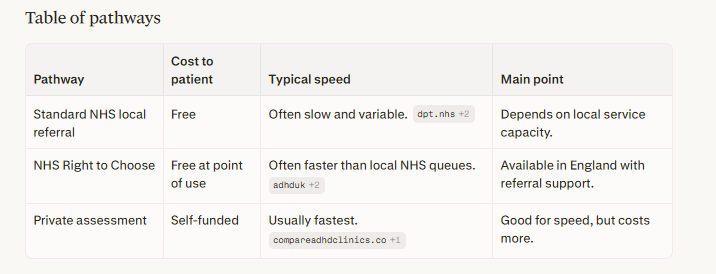
Right to Choose is NHS-funded, while private assessment is self-funded. That is the main difference, and it often determines the decision for many people.
Private care may offer faster access and more flexibility, but it comes with direct costs. Right to Choose can be a good middle ground when you need a shorter wait but want to stay within the NHS route.
The trade-off is that NHS-funded pathways can still be subject to restrictions, administrative delays, and variations in provider acceptance.
How to prepare well
Keeping a symptom diary can help, especially if you have trouble describing your difficulties in a short GP appointment. Write down examples of inattention, impulsivity, overwhelm, forgetfulness, missed deadlines, and how these issues affect work, study, or home life.nhs+1
It also helps to gather childhood evidence if you have it, such as old school reports or family observations. ADHD assessment usually looks for a long-term pattern, not just current stress.
If you are already struggling significantly, make a note of the impact on sleep, finances, relationships, and mental health. Clear examples can make your referral request stronger and your assessment more useful.
Table of pathways
FAQs
Is ADHD Right to Choose available in 2026?
Yes, for NHS patients in England, Right to Choose remains an option for ADHD assessment in 2026. ADHD UK and NHS-related pages continue to describe it as a valid route, although local restrictions may apply.
Can my GP refuse a Right to Choose referral?
A GP may decline if the referral is not clinically appropriate or if local rules limit access, but many patients do successfully use the pathway. Because some NHS areas have restrictions, it is worth checking local policy first.
Is Right to Choose free?
Yes, it is an NHS-funded route for eligible patients in England. That is one of its main advantages over private assessment.
How long does it take?
It depends on the provider. ADHD UK says the shortest waits change over time, and provider pages note that wait times are updated regularly because queues move.
Does a diagnosis through Right to Choose mean I can get medication?
Not automatically. Diagnosis and medication are separate stages, and some patients run into delays or complications during titration and shared care.
Are there any downsides?
The main downsides are restrictions in some areas, variable wait times, and the possibility of difficulties after diagnosis if local NHS systems do not handle the pathway smoothly.
Is Right to Choose better than private care?
It depends on your priorities. Right to Choose is better if you want an NHS-funded route, while private care may be better if you want the fastest possible access and can afford the cost.
Closing advice
ADHD Right to Choose can be a valuable route in 2026 for people in England who need a faster NHS-funded assessment. It can reduce waiting time, lower financial pressure, and give you more control over the provider you use.
The best results usually come from being organised, asking the right questions, and checking how the provider handles the full journey from referral to treatment. That way, you are choosing not just an assessment, but a workable path into care.
If you want a calmer, more supportive route to ADHD assessment and treatment, visit Focus Gently to explore private options and practical guidance while you decide the best next step.