Is a Private Adult ADHD Diagnosis Valid? UK Guide to Assessment, Treatment and Shared Care

Is a Private Adult ADHD Diagnosis Valid?
Yes—a private adult ADHD diagnosis can be valid in the UK. Its validity depends on the quality of the assessment and the clinician’s qualifications, not on whether the appointment was NHS-funded or privately paid for.
A private diagnosis should be made by an appropriately qualified healthcare professional with specialist training and experience in ADHD. It should follow recognised diagnostic criteria and include a full clinical assessment, developmental history, consideration of other explanations, and evidence that symptoms cause meaningful impairment in more than one area of life. That is the standard set out in NICE guidance for ADHD diagnosis.
However, “valid” does not always mean that every GP, NHS service, employer, university, or insurer must automatically act on the diagnosis in the same way. This distinction is important. A well-conducted private diagnosis can be clinically sound, but NHS-funded medication, shared care, or onward treatment may still depend on local policies and an individual clinician’s professional judgement.
The simple answer: private versus NHS diagnosis
The diagnostic criteria for ADHD do not change because you pay privately. ADHD is assessed against recognised clinical criteria, including persistent inattentive and/or hyperactive-impulsive symptoms, childhood onset, impairment, and the exclusion or identification of other possible causes. NICE states that diagnosis should be made by a specialist psychiatrist, paediatrician, or another appropriately qualified healthcare professional with training and expertise in ADHD.
In other words, an assessment’s standard matters far more than its setting. A private assessment that follows the same clinical principles as an NHS assessment can be equivalent in diagnostic quality. Somerset Council’s position statement makes this explicit: where a private assessment complies with NICE guidelines, it should be considered equivalent to an NHS assessment.somerset.gov
The issue is that private services vary widely. Some provide detailed, specialist-led assessments with robust reports and ongoing care. Others may offer brief, poorly evidenced assessments that do not give GPs or NHS teams enough information to make safe prescribing decisions. That variation is why it is essential to choose carefully.
What makes a private ADHD diagnosis credible?
A reliable private adult ADHD assessment should meet the same broad clinical standards expected in any high-quality ADHD service. NICE guidance says diagnosis must be based on:
A full clinical and psychosocial assessment.
Discussion of symptoms and behaviour across different areas of everyday life.
A full developmental and psychiatric history.
Observer reports where available.
An assessment of mental state.
Evidence of symptoms causing at least moderate impairment.
Evidence that symptoms occur in two or more important settings, such as home, work, education, family, or social life.
A comprehensive assessment commonly involves pre-assessment questionnaires, a long clinical interview, discussion of childhood experiences, information about work and relationships, relevant medical and mental-health history, and consideration of other possible explanations for concentration or organisational difficulties.
A diagnosis should not be based on an online quiz, a single short questionnaire, or a brief appointment that does not explore your developmental history and day-to-day functioning. Screening tools can be useful starting points, but they cannot diagnose ADHD on their own.
Why childhood evidence matters
ADHD is a neurodevelopmental condition. This means the clinician needs to establish whether symptoms were present during childhood, even if nobody recognised or diagnosed them at the time.
This does not mean you must have perfect school reports or a parent available to confirm every detail. Many adults do not have access to records or family support. But a qualified assessor should explore childhood patterns carefully, asking about school, homework, friendships, organisation, attention, behaviour, emotional regulation, and any support you needed.
They may review school reports, educational assessments, old records, or an informant form from someone who knew you as a child. The key is not a single piece of proof; it is whether the available evidence, your history, and clinical judgement support a persistent developmental pattern. NICE expects a full developmental history and observer reports as part of diagnosis.
Is a private ADHD diagnosis recognised by a GP?
A GP can recognise a private diagnosis and may use the report as useful clinical information. But a GP is not automatically obliged to accept every private report, prescribe medication recommended by a private clinician, or enter into a shared-care agreement.
This is because GPs retain responsibility for prescriptions they issue. They need enough assurance that the assessment, diagnosis, medication choice, dose, monitoring plan, and specialist support meet appropriate clinical standards. Local NHS policies can also influence whether shared care is offered.
A private assessment is therefore more likely to be useful to a GP when the report is thorough and includes:
The assessor’s name, registration, role, qualifications, and ADHD expertise.
A detailed assessment method and diagnostic rationale.
Childhood and adult symptom evidence.
Evidence of impairment in multiple settings.
Consideration of differential diagnoses and co-occurring conditions.
A clear diagnosis, including ADHD presentation where relevant.
A treatment recommendation with clinical reasoning.
A medication-titration and physical-monitoring plan, if medication is recommended.
Clear arrangements for follow-up and communication.
Even with a strong report, shared care is voluntary. It should never be promised by a private provider before your GP has agreed to it.
Can a private diagnosis get you NHS medication?
Not automatically. A private diagnosis and a recommendation for medication do not create an entitlement to NHS prescriptions. Some NHS systems may ask for the diagnosis to be reviewed or reconfirmed as NICE-compliant before NHS-funded treatment begins. A private diagnosis also cannot be used to bypass an NHS waiting list or skip the NHS service’s own assessment stage.
If a GP agrees to shared care, they may prescribe according to a specialist’s plan after you are stable on treatment. If they do not agree, medication and ongoing review may need to remain privately funded, unless you enter an NHS pathway and are assessed there.
This can be frustrating, but it reflects the professional responsibility attached to controlled-drug prescribing and the need for a safe, documented treatment plan. Before booking privately, ask the provider what happens after diagnosis, who undertakes medication titration, what follow-up they offer, and whether they will communicate clearly with your GP.
Do private ADHD clinics have to be CQC registered?
It depends on what the service provides. In England, independent providers offering ADHD diagnosis and treatment are in scope of Care Quality Commission regulation for the relevant regulated activity. However, the CQC states that a provider offering diagnosis only, without any treatment, does not need to register for that regulated activity.questions-statements.
This means CQC registration can be a relevant quality and governance signal where a clinic provides ongoing treatment or medication management, but it is not a universal test of whether every diagnostic-only service is legitimate or whether an individual assessment is clinically valid.
Instead of relying on one badge alone, check the clinician’s qualifications, professional registration, ADHD expertise, assessment process, written report, safeguarding processes, complaints process, and aftercare plan.
Questions to ask before booking a private ADHD assessment
Choosing a private provider is an important decision. Ask clear questions before paying:
Who will conduct the assessment, and what is their professional registration?
What ADHD-specific training and clinical experience do they have?
How long is the diagnostic appointment?
Does the assessment include a full developmental and psychiatric history?
How do you assess childhood symptoms?
Do you request informant information or school reports where available?
How do you assess co-occurring conditions, including anxiety, depression, autism, trauma, sleep problems, and substance use?
Will I receive a detailed diagnostic report?
What does the report include?
Do you provide medication titration and ongoing reviews if treatment is appropriate?
What are the full costs of assessment, treatment, prescriptions, follow-up, and annual review?
Do you offer a pathway if my GP declines shared care?
How do you communicate with my GP, with my consent?
A reputable service should answer these questions clearly. Be cautious about providers who guarantee a diagnosis, imply that a questionnaire alone is sufficient, rush the process, or promise that your GP will prescribe.
What if your GP declines shared care?
A declined shared-care request does not mean that your diagnosis is automatically invalid. It may mean that the GP has concerns about the report, does not have enough information to accept prescribing responsibility, is following a local policy, or does not feel able to provide shared care in that situation.
Ask for the reasons in writing if possible. This may help you and the private provider understand whether additional records, a clearer monitoring plan, or specialist communication could resolve the concern.
If you have a documented diagnosis but your treatment pathway has stalled, Focus Gently’s private ADHD titration and ongoing-support service offers an eligibility check and, with your consent, a review of existing clinical records before taking over ongoing care where clinically appropriate. The service is CQC-registered, provides remote UK-wide care, and is led by a Nurse Independent Prescriber.focusgently
The service is designed for people who have already been diagnosed elsewhere and need continuity after delayed reviews, an interrupted pathway, or a declined shared-care request. It is not a substitute for an initial diagnostic assessment where no adequate diagnosis or records are available.focusgently
Can an employer or university accept a private diagnosis?
Often, a detailed private diagnostic report can be used as evidence when asking for reasonable adjustments at work or support in higher education. However, each employer, university, professional body, insurer, or examination provider has its own process and may request specific evidence.
A good report will clearly explain the diagnosis, how symptoms affect daily functioning, and any recommended adjustments. Examples might include additional time, a quieter workspace, written instructions, task-management support, flexible working arrangements, or assistive technology.
If you need workplace or university support, ask your provider whether their report includes practical adjustment recommendations or whether a separate occupational-health or disability-support assessment may be useful.
What should a private ADHD report contain?
A high-quality report should be more than a one-page diagnosis letter. It should provide enough information for you, your GP, and any future clinician to understand how the conclusion was reached.
Look for:
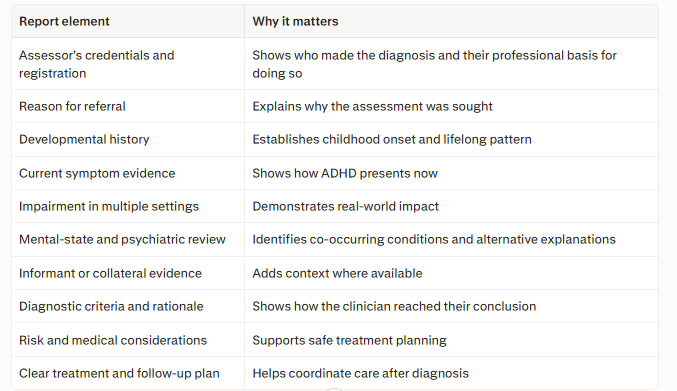
Even the strongest report does not guarantee GP shared care. It does, however, give the GP and any future clinician the information needed to assess the recommendation responsibly.
Can a private diagnosis lead to NHS medication?
Not automatically. A private ADHD diagnosis does not create an automatic right to NHS prescriptions, NHS medication titration, or shared care. Some NHS services may ask to review or reconfirm a private diagnosis before providing NHS-funded treatment.
If your GP agrees to shared care after a specialist has diagnosed ADHD, started medication, completed titration, and stabilised the dose, they may continue prescribing under the agreed plan. If shared care is declined, ongoing medication and reviews may need to stay private unless you enter an NHS ADHD pathway.
It is important to ask any private provider about this before you book. Ask who will prescribe during titration, how frequently you will be reviewed, what ongoing care costs, whether the provider will write to your GP, and what support remains available if shared care is not accepted.
Does CQC registration matter?
It can matter, particularly if a provider offers ADHD treatment and ongoing medication management. In England, the Care Quality Commission regulates independent providers carrying out relevant regulated activities, including treatment of disease, disorder, or injury. However, the CQC explains that a service offering ADHD or autism diagnosis only, without treatment, may not need registration for that activity.cqc.org
Therefore, CQC registration is a useful indicator of governance when a clinic provides treatment, prescribing, and follow-up. But it is not the sole measure of whether a diagnostic assessment is credible.
When choosing a provider, look at the whole service:
Is the clinician professionally registered?
Do they have clear ADHD expertise?
Is the assessment comprehensive?
Do they provide a detailed written report?
Is there a complaints and safeguarding process?
Is medication care available if needed?
Are costs transparent?
Is there a plan for monitoring and continuity?
What if your GP refuses shared care?
A GP declining shared care does not automatically mean your diagnosis is invalid. Shared care can be declined for many reasons, including local policy, lack of confidence in a report, missing monitoring information, limited specialist follow-up, or concerns about taking responsibility for a controlled medication.
If this happens, ask politely for the reason in writing. This can help you understand whether there is a practical issue that the private provider can address, such as supplying a fuller report, monitoring plan, or specialist letter.
If you have already received a documented ADHD diagnosis but need ongoing support after a delayed titration pathway, interrupted care, or a declined shared-care request, Focus Gently’s private ADHD titration and ongoing-support pathway offers a records review to assess whether a transfer of care is clinically appropriate. The service is CQC-registered, remote and UK-wide, and led by a Nurse Independent Prescriber.focusgently
This pathway is designed for adults with an existing diagnosis and appropriate supporting documentation. It is not intended to replace a full ADHD diagnostic assessment for someone who has not yet been assessed.
Can a private ADHD report help at work or university?
Often, yes. A detailed private diagnostic report may support requests for reasonable adjustments at work, university, professional training, or examinations. However, each organisation has its own process and may ask for particular evidence.
Possible adjustments may include:
Written instructions and meeting summaries.
Extra time for tests or assessments.
A quieter workspace.
Flexible working arrangements.
Task-management tools or software.
More frequent check-ins.
Breaking large tasks into smaller milestones.
Support with planning, prioritisation, or workload management.
A useful report should explain not only that ADHD has been diagnosed but also how symptoms affect functioning and what adjustments may help.
Questions to ask before booking privately
Before paying for a private ADHD assessment, ask:
Who will assess me, and what are their qualifications and professional registration?
How much experience do they have in adult ADHD?
How long is the assessment appointment?
Do you assess childhood symptoms and developmental history?
Do you consider anxiety, depression, autism, trauma, sleep disorders, and physical-health factors?
Can I provide school reports or an informant form?
Will I receive a detailed diagnostic report?
Do you offer treatment, medication titration, and regular follow-up?
What are the full costs beyond the first assessment?
How do you communicate with GPs about shared care?
What happens if my GP declines shared care?
Can you provide continuity if my previous ADHD clinic has stopped offering support?
A reputable provider will answer these questions directly. Avoid services that promise guaranteed diagnoses, use vague descriptions of their process, or make assumptions about what your GP will agree to do.
The benefits and limits of private assessment
Private assessment can offer faster access, flexible appointments, remote consultations, clinician choice, and a clearer pathway than some NHS routes. For many adults, it provides an opportunity to understand years of difficulties with focus, organisation, emotional overwhelm, or impulsivity.
However, it also requires realistic planning. Private care can involve costs beyond the diagnostic appointment, particularly if you need medication titration, prescriptions, follow-up reviews, annual reviews, or private monitoring. NHS shared care is not guaranteed, even with a valid diagnosis.
The most important question is not simply, “Is private assessment faster?” It is, “Does this provider offer a comprehensive, safe, evidence-based assessment and a sustainable plan for after diagnosis?”
Frequently asked questions
Is a private adult ADHD diagnosis valid in the UK?
Yes. A private ADHD diagnosis can be valid when it is made by an appropriately qualified clinician with ADHD expertise and follows recognised clinical standards, including a comprehensive assessment, developmental history, evidence of impairment, and consideration of other possible explanations.
Will the NHS accept a private ADHD diagnosis?
It may, but acceptance is not automatic. An NHS service or GP may review the quality of the assessment and decide whether further information or reassessment is needed before offering NHS-funded treatment or shared care.
Can my GP prescribe ADHD medication after a private diagnosis?
Possibly, but only if your GP agrees to do so. In many cases, a specialist must first diagnose ADHD, start medication, complete titration, and stabilise the dose before shared care is considered. GPs are not obliged to accept shared care.
Is CQC registration necessary for a private ADHD diagnosis?
Not always. The CQC says that diagnostic-only ADHD services may not need registration for treatment-related regulated activity. However, CQC registration is relevant where a provider offers treatment and ongoing medication management.cqc.org
Can a private ADHD diagnosis be used for workplace adjustments?
Often, yes. A detailed diagnostic report may help you request reasonable adjustments at work or support at university. The organisation may have its own evidence requirements, so check what documentation it needs.
What should I do if my private ADHD clinic has stopped treatment?
Request copies of your diagnostic report, medication history, titration records, and monitoring results. If you have an established diagnosis, Focus Gently can review your existing records to determine whether ongoing titration or treatment support may be appropriate.focusgently
Final thoughts
A private adult ADHD diagnosis is valid when it is clinically robust, properly documented, and completed by an appropriately qualified clinician. The fact that you paid for the assessment does not make the diagnosis less real.
The key is choosing a provider that offers more than a diagnosis letter: look for a detailed assessment, a clear report, safe treatment planning, and a realistic plan for what happens if you need medication or ongoing care.