Can a Private ADHD Diagnosis Help With Work or Study Support?

Can a Private ADHD Diagnosis Help With Work or Study Support?
A private ADHD diagnosis can help you access support at work, university, college, or training—provided the assessment is clinically robust and the report clearly explains how ADHD affects your day-to-day functioning. It may support requests for reasonable adjustments, disability support, Disabled Students’ Allowance (DSA), and practical workplace assistance.
However, a diagnosis does not automatically guarantee every adjustment or source of funding. Employers, universities, professional bodies, and government schemes each make their own decisions, usually based on the impact ADHD has on you rather than on the diagnostic label alone.
The most useful private ADHD report does more than state, “This person has ADHD.” It explains the diagnosis, identifies functional difficulties, and gives practical recommendations that relate to your work or study environment.
Why a diagnosis can make support easier
Many adults with ADHD have spent years coping by working longer hours, relying on last-minute urgency, over-preparing, or asking friends and family for help. From the outside, this may look like success. Internally, it can feel like constant stress, missed deadlines, exhaustion, and fear of being found out.
A diagnosis can provide a framework for explaining these difficulties. It can help you move away from describing yourself as lazy, careless, unmotivated, or disorganised and toward a more accurate conversation about attention regulation, executive function, time management, working memory, and emotional overload.
In practical terms, a diagnostic report may help you show why certain work or study tasks are harder, what barriers you experience, and which adjustments could reduce those barriers.
Is a private ADHD diagnosis accepted?
A private ADHD diagnosis can be valid when it is made by an appropriately qualified clinician and follows recognised clinical standards. The location or funding route of the assessment does not determine whether ADHD is real or whether the diagnosis is clinically credible.
For support purposes, organisations will usually focus on whether the document:
Confirms the diagnosis.
Names the clinician and their professional role.
Explains the impact of ADHD on daily functioning.
Is recent enough for the purpose requested.
Includes relevant recommendations or evidence of support needs.
For example, UK universities commonly accept existing ADHD assessment reports, specialist letters, GP letters, or a GP record summary as evidence, provided the documentation confirms the diagnosis, is written by an appropriate professional, and describes functional impact.
The key point is this: a private diagnosis can be valuable evidence, but you should check the specific evidence requirements of your employer, university, funding body, or professional regulator before submitting it.
ADHD and workplace support
At work, ADHD may affect planning, prioritising, time estimation, remembering verbal instructions, managing interruptions, shifting between tasks, regulating emotions, or meeting deadlines. These difficulties can be particularly hard in fast-paced roles, open-plan offices, remote work environments with minimal structure, and jobs with high administrative demands.
A diagnosis can help you begin a more focused discussion with your manager, HR team, occupational-health service, or workplace wellbeing contact.
Possible workplace adjustments may include:
Written instructions or follow-up notes after meetings.
Clear priorities and agreed deadlines.
Breaking large projects into staged milestones.
A quieter workspace, noise-cancelling headphones, or reduced interruptions.
Flexible start times where this is feasible.
Regular check-ins with a manager.
Support with planning, task prioritisation, and workload management.
Extra time for complex written tasks.
Permission to use task-management software, timers, reminders, or dictation tools.
Advance notice of major changes where possible.
More structured meetings, with agendas and action points.
The best adjustments are individual. Not everyone with ADHD needs the same support, and an employer does not have to agree to every request. A useful approach is to identify the specific work barrier and propose a practical adjustment that is likely to help.
For example, instead of asking vaguely for “more flexibility,” you could say: “I lose track of verbal action points after fast meetings. Could I receive a written summary or five minutes at the end of each meeting to confirm priorities?”
Does ADHD count as a disability at work?
ADHD may meet the definition of disability under the Equality Act 2010 if it has a substantial and long-term adverse effect on your ability to carry out normal day-to-day activities. This is not determined by diagnosis alone. The functional impact and duration of your difficulties matter.
You do not need to wait for a tribunal decision before requesting support. However, for an employer’s duty to make reasonable adjustments to arise, the employer generally needs to know—or reasonably be expected to know—about your disability or relevant difficulties.
A private diagnostic report can help provide evidence, particularly if it explains the ways ADHD affects ordinary activities and job tasks. But you control how much information you share. You may choose to disclose the diagnosis, describe the functional impact without sharing every personal detail, or first speak confidentially to HR or occupational health.
How to use a private report at work
Before sharing your full report, check your workplace policy and consider what information is genuinely necessary. Your diagnostic report may contain sensitive personal details about childhood, mental health, family history, and relationships that an employer does not need to see.
You could instead ask your clinician for a short letter that confirms:
The ADHD diagnosis.
That it is a long-term neurodevelopmental condition.
The main functional effects relevant to your role.
Suggested reasonable adjustments.
Whether occupational-health input would be helpful.
It can also help to write your own short statement explaining the practical impact in your job. Focus on outcomes and solutions rather than only symptoms.
For example:
“I have ADHD, which affects my working memory and time estimation. I work best when priorities are written down and larger tasks are divided into agreed milestones. I would like to discuss using a shared task list and a short weekly planning meeting.”
This makes it easier for your employer to understand both the problem and the proposed solution.
ADHD support at university and college
A private ADHD diagnosis can also help you access support in higher education. Universities and colleges usually have a disability, inclusion, learning-support, or wellbeing team that can review evidence and create an individual support plan.
Depending on the institution, possible study adjustments may include:
Extra time in exams or timed assessments.
Rest breaks during exams.
A quieter examination room.
Deadline flexibility in some circumstances.
Lecture recording or note-taking support.
Assistive technology.
Study-skills support.
Mentoring or specialist ADHD coaching.
Early access to reading lists or course materials.
Help with planning and workload management.
The diagnosis alone is not the full story. The most persuasive evidence explains how ADHD affects you in academic life: for instance, difficulty processing information in fast lectures, organising large assignments, starting independent study, managing multiple deadlines, or maintaining concentration in noisy settings.
Disabled Students’ Allowance and ADHD
Disabled Students’ Allowance, known as DSA, can help eligible UK higher-education students with extra study-related costs arising from a disability, long-term health condition, mental-health condition, or learning difference. ADHD is included among the conditions for which students can apply.
For DSA in England, applicants need evidence from a doctor or medical professional that confirms the diagnosis and explains how the condition has a substantial and long-term effect on day-to-day activities. The evidence may be a report, letter, or a completed disability evidence form, depending on the circumstances.
A formal private ADHD diagnostic report may be useful evidence if it clearly states:
Your full name and diagnosis.
The date of assessment.
The name, role, and professional registration of the clinician.
How ADHD affects your everyday functioning and study.
Any relevant recommendations.
Requirements vary across the UK nations and individual funding bodies, so always check the relevant DSA guidance and your university’s disability-support team. Some universities may also accept a working diagnosis or other medical evidence while you wait for a formal assessment.
What DSA may fund
DSA is not usually a cash payment for general living costs. It can contribute to study-related support and equipment that helps reduce barriers created by ADHD.
Following a needs assessment, support may include:
Specialist one-to-one study skills support.
ADHD-focused mentoring.
Assistive technology, such as planning, dictation, or mind-mapping software.
A computer or equipment contribution where appropriate.
Printing, recording, or organisational support in some cases.
Travel support where a disability makes public transport difficult.
The exact support depends on your individual needs assessment. A diagnosis opens the door to the process; the needs assessment determines what support is appropriate.
Access to Work and ADHD
Access to Work is a UK government scheme that may help people with a disability or health condition start work, stay in work, or move into self-employment. It focuses on practical employment support beyond the reasonable adjustments an employer is legally expected to make.
A formal ADHD diagnosis is not always required to apply. The application focuses on how your condition affects your work. However, medical or specialist evidence can still be useful, especially if the impact or recommended support needs to be clarified.
Potential Access to Work support may include:
ADHD coaching.
Specialist strategy support.
Assistive technology.
Equipment.
Travel support in appropriate circumstances.
Communication or workplace support.
Access to Work does not generally fund an ADHD diagnosis, medication, or treatment itself. It also does not replace an employer’s responsibility to make reasonable adjustments.
Choosing the right support route
Different support routes serve different purposes:
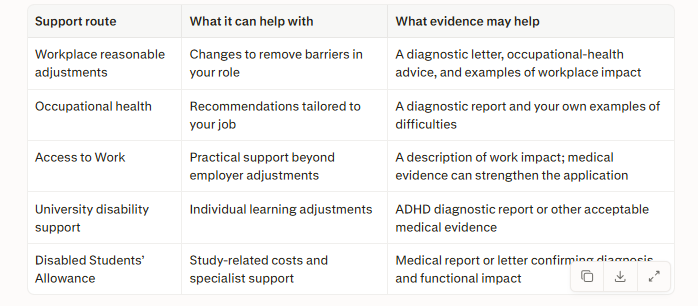
Your private ADHD diagnosis may be relevant in each setting, but the report is strongest when paired with a clear explanation of your own needs.
What to ask your private ADHD provider for
If you hope to use your assessment for work or study support, ask the provider before booking whether their report includes practical functional recommendations. Not every diagnostic report is written with workplace or university evidence in mind.
Useful questions include:
Will the report confirm the diagnosis and clinical rationale?
Will it describe the impact of ADHD on work, study, and everyday activities?
Can you provide adjustment recommendations?
Can you provide a brief supporting letter if my university or employer requires one?
Will the clinician’s professional role, registration, and assessment date be clear?
Is there an additional charge for a supporting letter or workplace documentation?
Can you liaise with occupational health or a disability-support team if needed?
A report that is detailed, clear, and tailored to functioning is much more useful than a short diagnosis-only letter.
If you already have a diagnosis but support has stalled
Some people already have a documented ADHD diagnosis but face a different problem: their medication pathway has stalled, their previous provider has stopped responding, or their GP has declined shared care. This can make it harder to maintain the stability needed to work or study effectively.
If you have an existing diagnosis and relevant clinical records, Focus Gently’s private ADHD titration and ongoing-support pathway may be able to help you continue care after an eligibility check and records review. The service is CQC-registered, led by a Nurse Independent Prescriber, and delivered remotely across the UK.focusgently
Focus Gently’s pathway is designed for adults who were diagnosed elsewhere and need continuity of medication-related clinical support. It is not a replacement for an initial diagnostic assessment when no documented diagnosis is available.focusgently
FAQs
Can a private ADHD diagnosis help me get reasonable adjustments at work?
Yes. A robust private diagnostic report can help support a request for reasonable adjustments, especially when it explains how ADHD affects your work and recommends practical changes. Whether ADHD meets the Equality Act definition of disability depends on whether the condition has a substantial and long-term adverse effect on normal day-to-day activities.
Do I have to tell my employer that I have ADHD?
No. You are not generally required to disclose an ADHD diagnosis. However, if you want your employer to consider reasonable adjustments, they need enough information about your condition or its functional effect to understand the support you need. You can discuss disclosure confidentially with HR or occupational health first.
Can I use a private ADHD diagnosis to apply for Disabled Students’ Allowance?
Often, yes. DSA applicants with ADHD need medical evidence that confirms the diagnosis and explains the substantial, long-term effect on day-to-day activities. A private report or letter from an appropriate medical professional may meet this requirement if it contains the necessary information.
Can I apply for Access to Work without a formal ADHD diagnosis?
Possibly. Access to Work focuses on how a condition affects your ability to do your job, and a formal diagnosis is not always required. However, evidence from a qualified professional can help explain the impact and support needs.
What should an ADHD report say for university support?
It should confirm the diagnosis, identify the clinician and their professional role, explain how ADHD affects study and everyday functioning, and ideally include practical recommendations. Universities may also have their own documentation requirements, so check with the disability-support team before submitting it.
Will a diagnosis automatically get me extra time in exams?
No. Exam adjustments are decided by your school, college, university, or examination body based on evidence of need and their policies. A diagnosis can support the request, but the organisation will usually consider the specific functional impact and the adjustments that are reasonable.
Book an ADHD Assessment
You should not have to keep working twice as hard just to appear as though you are coping. A high-quality ADHD assessment can give you clarity about your symptoms, provide clinical evidence for work or study support, and help you take the next step toward a more sustainable way of living.
If you already have an ADHD diagnosis but your medication care, reviews, or shared-care pathway has stalled, book or enquire about private ADHD titration and ongoing support with Focus Gently. The process begins with a short eligibility questionnaire, followed by a review of your existing clinical records before any care is taken on. Focus Gently provides remote, UK-wide support with no GP referral required.